
Ambient AI: Transforming Technology and Business
Ambient AI is emerging as a quietly powerful force in technology and business. It runs in the background, senses context, and acts without prompts. As a result, it transforms how teams work and how products respond. Because it monitors signals continuously, ambient systems reduce friction and speed decisions.
However, this always-on capability raises sharp questions about privacy and control. Yet, when designed with consent and safeguards, ambient AI delivers real productivity gains. Imagine assistants that join meetings, summarize notes, and act on your behalf. Imagine email cleaners that triage mail, calendar managers that block focus time, and supply chains that self-optimize.
For businesses, this means faster workflows, lower costs, and smarter automation. However, organizations must balance innovation with strong governance and simple opt-in controls. Therefore, this article will explain how ambient agents work and how to build them safely. Along the way, we will explore tools, best practices, and real product examples.
What is Ambient AI?
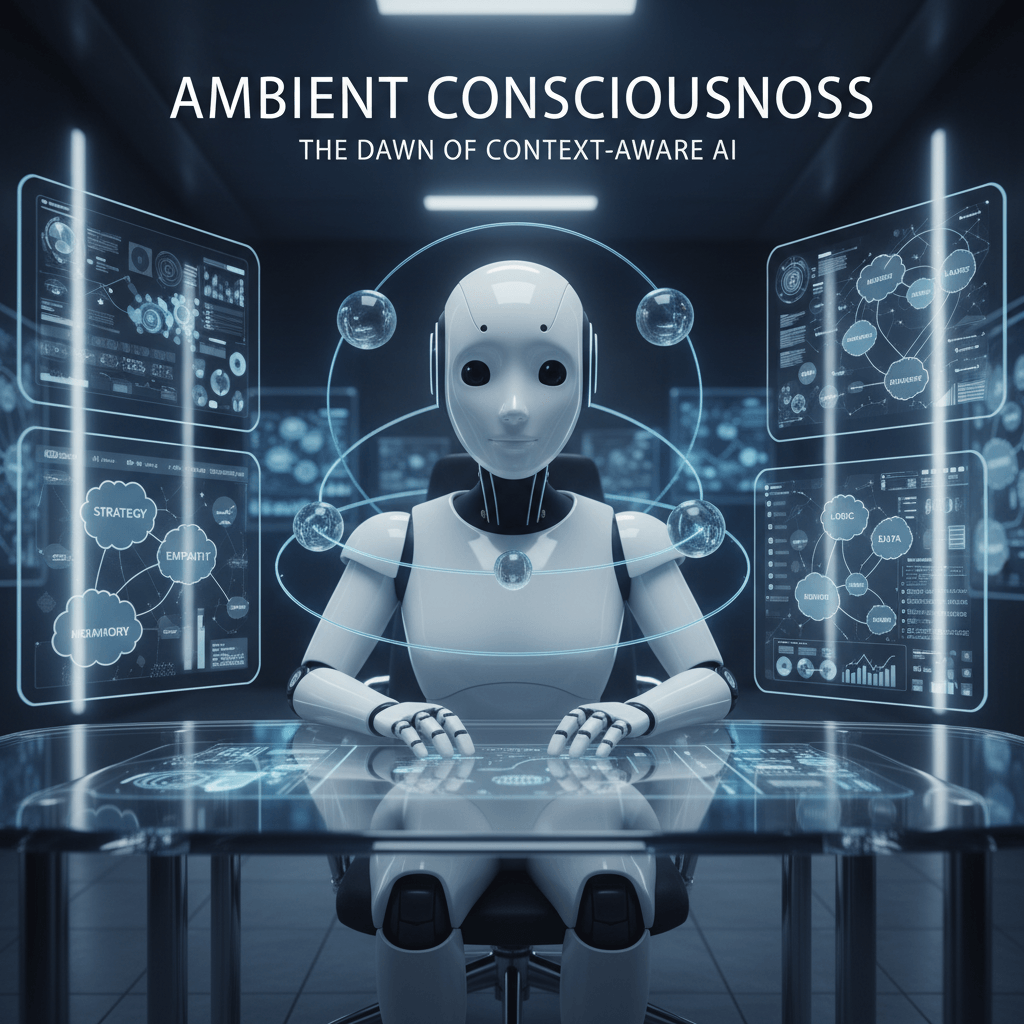
Ambient AI describes systems that monitor their environment, interpret context, and act without explicit prompts. Because it senses continuously, ambient AI enables context-aware intelligence and reduces friction in workflows.
Key features of ambient AI
- Always-on sensing and monitoring using sensors, logs, and connectors. As a result, systems detect changes in real time.
- Context-aware intelligence that understands who, when, and where. Therefore it personalizes actions and responses.
- Background automation and proactive tasking rather than waiting for chat prompts. This creates ubiquitous AI environments that feel invisible.
- Memory banks and unified memory for continuity across sessions and devices. Thus agents keep context and learn preferences.
- Agent frameworks, tool calling, and prompt engineering to orchestrate complex tasks. However, this is not AGI; it relies on pattern-matching and pipelines.
- On-device processing and NPUs for speed, cost savings, and privacy when possible.
How ambient AI differs from traditional AI
- Traditional chatbots wait for prompts. Ambient agents act proactively and continuously.
- Many legacy models are stateless and reactive. Ambient systems keep state and context over time.
- Cloud-only setups face latency and privacy limits. Conversely on-device and hybrid designs lower risk and cost.
- Traditional automation needs explicit triggers. Ambient AI infers intent from signals and sensors.
Practical notes and reading
For speech capture that fuels many ambient features, see this article. For platform integration and product examples, check AllosAI. For a view of Allos AI’s broader research and case studies, see this blog post.

Applications and Benefits of Ambient AI
Ambient AI powers smart assistants and contextual AI across homes, offices, and industries. It listens to signals, learns patterns, and acts with minimal prompting. Therefore it unlocks new forms of AI-driven automation and better user experiences.
Industry use cases
- Enterprise productivity: Meeting assistants can auto-join, transcribe, and extract action items. For example, Fireflies automates meeting capture and follow-ups at scale. As a result teams spend less time on admin.
- Customer service and sales: Ambient agents can surface CRM context and suggest next steps. Zapier enables agent-style automation that watches apps and triggers workflows. This reduces manual handoffs.
- Healthcare documentation: Dragon technology and Copilot features speed clinical notes and reduce clinician burden. Therefore ambient systems improve charting accuracy.
- Retail and supply chain: Blue Yonder uses signals to plan orders, optimize layouts, and route workers. Thus operations run with fewer delays.
- Personal life and devices: On-device assistants manage calendars, notifications, and inbox tidy-up without cloud latency.
Core benefits
- Enhanced personalization because agents remember preferences and context.
- Continuous automation that reduces context switching and manual tasks.
- Faster decisions due to real-time, contextual signals.
- Better user experience when the system feels invisible and helpful.
- Cost savings from reduced latency and smarter resource use.
Practical notes
Voice capture often powers ambient behaviors. See an Allos AI guide to dictation and speech-to-text for details. For product integrations and examples, visit AllosAI. For additional case studies and research, see this link.
| Technology | Primary use case | Key features | Integration | Benefits | Privacy notes |
|---|---|---|---|---|---|
| Zapier Agents | App automation, background workflows | Watches apps, triggers, tool calling, connectors | Thousands of apps, webhooks, APIs | Orchestrates tasks without prompts, reduces manual handoffs | Configurable scopes, opt-in, audit logs |
| Fireflies | Meeting capture and follow-ups | Auto-join, transcription, action item extraction, search | Zoom, Google Meet, Slack, CRMs | Faster follow-ups, searchable transcripts | Recording consent, retention controls |
| OpenClaw | Inbox and message management | Cleans inbox, drafts replies, calendar actions, messaging automation | Email clients, WhatsApp, Telegram integrations | Reduces email load, automates triage | Local processing option, user consent |
| TwinMind | Meeting listening and research capture | Continuous listening, context store, local memory, chat queries | Chrome extension, local store | Second brain, unified memory across sessions | Local storage, user-controlled retention |
| Microsoft Recall and Dragon | Clinical notes, screen timeline retrieval | Speech-to-text, timeline snapshots, clinical drafting | EHRs, Windows, Copilot integrations | Faster documentation, timeline search | Enterprise compliance, least-privilege controls |
| Blue Yonder | Retail and supply chain optimization | Demand planning, warehouse layout, route optimization | ERPs, IoT sensors, WMS | Reduced delays, optimized operations | Operational data governance, role-based access |
Ambient AI and AllosAI Solutions
Ambient AI is reshaping how products and teams behave. It senses context, acts continuously, and removes friction. As a result, businesses see faster decisions and smarter automation. However, this power demands guardrails around privacy and consent.
AllosAI offers a unified AI automation platform to help teams scale communication, content, and engagement. It acts as a central AI engine for modern organizations, unifying external chatbot systems and workflow automation. Also, its Social Media Hub connects channels and automates posting and responses at scale. Moreover, its automation tools streamline interactions and reduce repetitive work.
Therefore adopt ambient patterns carefully, because they deliver productivity and better experiences. Get started by exploring AllosAI for integrations and scaled automation at AllosAI. Also try the app platform at AllosAI App and read guides at AllosAI Blog. The future blends invisible intelligence with clear human control.
Start small with opt-in features, visible indicators, and short retention windows to build trust. As a result, teams adopt ambient AI faster and safer.
Frequently Asked Questions (FAQs)
What is ambient AI?
Background system that monitors environment and acts without explicit prompts, providing context-aware intelligence.
Reduces friction and speeds decisions through continuous sensing and seamless assistance.
How does ambient AI differ from chatbots or traditional AI?
Acts proactively instead of waiting for prompts; enables background automation.
Keeps memory and context over time, making it feel like a persistent assistant rather than a reactive tool.
Where is ambient AI used today?
Meetings and productivity: auto-join, transcribe, extract action items.
Messaging and personal assistants: inbox triage, draft replies, calendar management.
Healthcare and operations: clinical dictation, retail and supply chain optimization.
Is ambient AI safe and private?
Use explicit opt-in, visible recording indicators, and clear user consent.
Prefer short default retention, easy deletion, and least-privilege access controls.
Maintain audit logs and require approvals for high-impact actions.
How should businesses get started with ambient AI?
Start small with opt-in features and visible controls; pilot simple automations.
Use hybrid on-device/cloud approaches to reduce latency and risk.
Define governance, retention policies, and approval workflows before scaling.