

Why AI in customer support and API integration Will Redefine Service
AI in customer support and API integration is transforming how teams solve problems and scale support. Because automation now combines natural language intelligence with system-level connections, businesses can resolve tickets faster and more accurately. As a result, customers get faster answers and agents focus on higher-value work.
This article shows why this shift matters and how to build support-first AI agents. We explain practical design steps, conversation design best practices, and guardrails for safe automation. However, we also highlight the critical role of clean APIs and data flows because integrations power retrieval, actions, and personalized responses.
You will read clear examples from real deployments and learn how to measure success. Therefore you can decide what to pilot first and how to scale across teams. The guidance that follows targets support teams, product leaders, and engineers who want a unified customer experience. Read on to learn how to pair human-centered conversation design with robust API integration to unlock faster resolution, better retention, and measurable ROI.
AI in customer support and API integration: How it enhances support
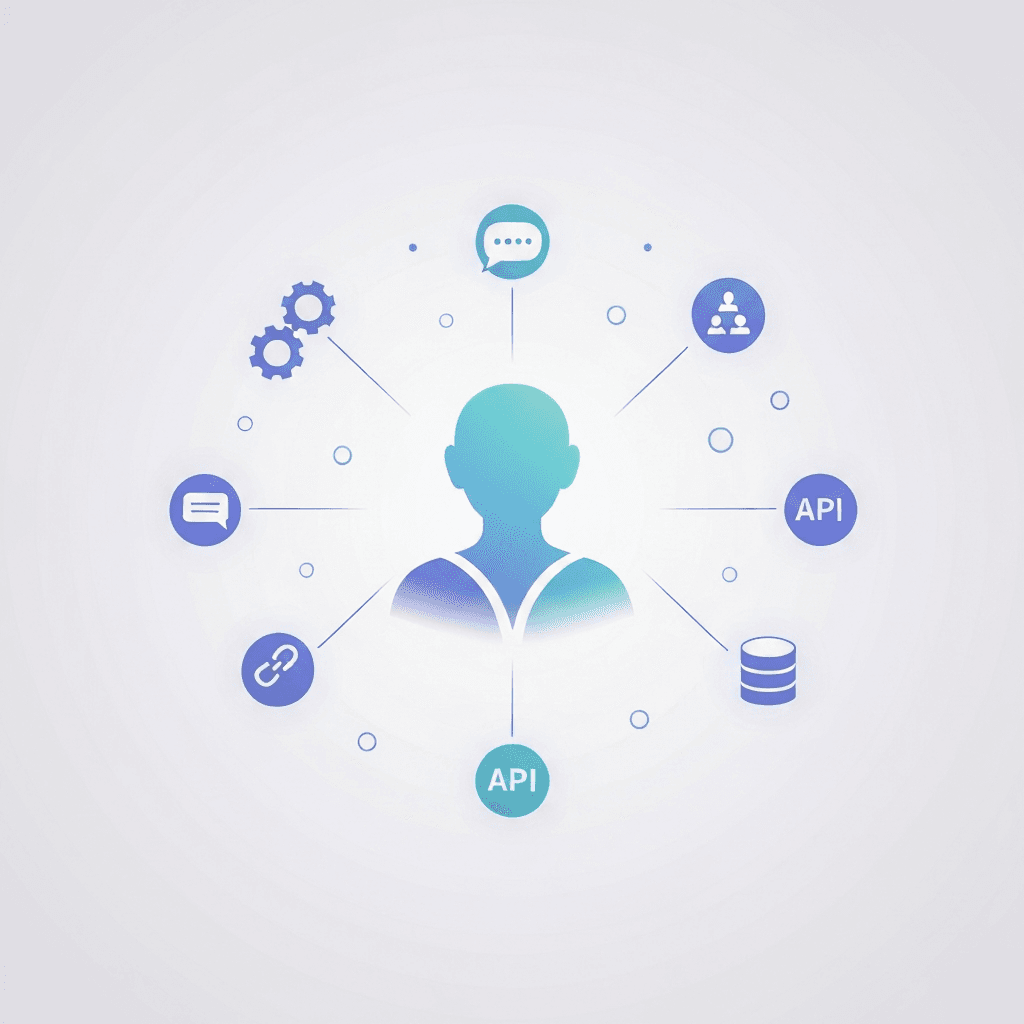
AI in customer support and API integration connects conversational intelligence with backend systems. Because of this, bots can read customer context and take actions. As a result, teams resolve issues faster and at lower cost.
Key benefits and insights
-
Automation and repeatable tasks
AI handles routine requests and frees agents for complex work. For example, bots can reset passwords, check order status, or escalate tickets automatically. To see automation patterns, review real-world examples: real-world examples.
-
Faster response time and reduced wait
Because AI routes and triages messages instantly, first response times fall sharply. Therefore customers get answers faster and satisfaction improves.
-
Personalization at scale
AI uses customer history and preferences to tailor replies. However, this only works with connected data sources and context memory. Link systems so agents use unified profiles.
-
Reliable data syncing across platforms
Clean API integration keeps profiles, orders, and intents in sync. For middleware options, see middleware options. Because synced data reduces repeated requests, it lowers friction and improves conversion.
-
Actionable operations and self-service
When APIs allow actions, bots do more than suggest. For example, they can create refunds, change subscriptions, or book appointments, all via safe API calls. Use guardrails and audit logs to keep actions secure.
-
Easier no-code and low-code automation
Finally, no-code tools accelerate pilots and proofs of concept. For a practical how-to on AI helpers and Zapier, read this guide. Also review API fundamentals for integration patterns and best practices.
Quick comparison: AI customer support tools and API capabilities
Below is a concise table that shows common API features, unique benefits, ease of use, pricing signals, scalability, and target users. Use this to match tool strengths to your integration needs.
| Tool | API features | Unique benefits | Ease of use | Pricing (signal) | Scalability | Target users |
|---|---|---|---|---|---|---|
| Intercom | REST API; webhooks; conversation and user APIs; app framework | Strong inbox workflows; built‑in bots; tight product messaging | High for support teams | Tiered SaaS pricing; add‑ons for automation | Enterprise ready; scales with seats and apps | Support and product teams needing integrated comms |
| Zendesk | REST API; webhooks; apps framework; ticket and user endpoints | Robust ticketing and reporting; broad ecosystem | Familiar to support ops | Tiered SaaS; enterprise plans for APIs | Proven at large scale; multi‑brand support | Large service orgs and contact centers |
| OpenAI Responses API | Generative models; streaming, embeddings, multimodal inputs | Best for natural language understanding and generation | Moderate for engineers | GPT‑5.4 pricing: Input $2.50, Output $15.00 per million tokens | Highly scalable API infrastructure | Teams building custom conversational experiences |
| Fin (Customer Agent) | Conversational agent APIs; action connectors; context memory | Support‑first agents with sales lift examples | Moderate; productized for chat use cases | Typically SaaS with implementation fees | Optimized for high‑velocity chat flows | Companies seeking packaged AI agents for support and sales |
| Zapier (AI + Integrations) | Connectors for 5,000+ apps; triggers and actions; AI steps | Fast no‑code automation and prototyping | Very high for non‑engineers | Subscription tiers; pay per task | Great for pilots and cross‑system automation | Ops teams and small dev teams prototyping integrations |
How to pick
- Prioritize API access if you need custom actions and context memory. Therefore you can build richer automations.
- Choose low‑code tools for fast pilots, and robust APIs for production scale.
- Also consider security, audit logs, and governance when enabling write actions.
Practical use cases: AI in customer support and API integration in action
AI in customer support and API integration delivers measurable impact across common support workflows. Because APIs connect agents to CRM, billing, and order systems, bots do useful work beyond chat. As a result, teams reduce manual tasks and speed resolutions.
Use cases and clear payoffs
- 24/7 triage and escalation
Bots answer common questions any time, then escalate complex issues to humans. For example, WHOOP’s Fin resolved 84 percent of inbound Join page questions, freeing agents for deep work.
- CRM integration and real time context
Connected agents pull purchase history and support notes in real time. Therefore reps see context instantly and avoid repeated questions.
- Automation of repetitive tasks
Bots execute resets, refunds, and status checks via API calls. This reduces error and saves agent minutes per ticket.
- Lead capture and conversion lift
AI qualifies leads by asking qualifying questions and writing CRM records. WHOOP and Intercom drove a 130 percent increase in attributable sales after deploying Fin.
- Proactive outreach and retention
Systems trigger messages when usage drops or subscriptions renew. As a result, churn falls and LTV improves.
- Internal efficiency and routing
AI routes tickets to the right team using intent and tags. Finally, integrations feed analytics that improve workflows.
How to capture value quickly
To pilot quickly, start with high volume, low risk automations. Measure resolution rate, handle time, and conversion lift. With clear guardrails and API governance, teams can scale safely and see strong ROI.
Conclusion: Turn integrations into impact
AI in customer support and API integration unlocks faster resolutions and lower operational cost. Because AI connects conversations to systems, teams automate routine work and preserve human effort for complex cases. As a result, response times fall, conversions rise, and customers enjoy more consistent experiences.
AllosAI acts as a unified AI automation platform for social media and first-line support. It integrates deeply with APIs to run actions, sync data, and keep context across channels. Therefore you can automate workflows without hiring more staff. Moreover operational costs drop, response time improves, and audience interaction becomes more timely and personal.
Explore AllosAI to see these gains for your team. Visit the website at AllosAI, try the app at AllosAI App, and read guides on the blog at AllosAI Blog. Finally, test a small pilot, measure resolution and conversion, and then scale the automations that move the needle.
Frequently Asked Questions (FAQs)
What is AI in customer support and API integration?
It combines conversational AI with system connections. Because APIs let agents access data and run actions, bots do real work. As a result, they can resolve tickets, update profiles, and trigger workflows. This pairing creates a unified customer experience.
How does API integration improve AI responses?
By providing context and capabilities:
- Pulls purchase history and support notes in real time.
- Enables actions such as refunds, bookings, or subscription changes.
- Reduces repeated questions and speeds resolution.
Therefore personalization and automation scale together.
What implementation challenges should teams expect?
Common challenges include data quality, security, and governance. However you can mitigate these with clean APIs, scoped permissions, and audit logs. Start small, add guardrails, and measure before scaling.
How quickly can organizations see results?
Results often appear within weeks for high volume flows. For example, Fin resolved 84 percent of WHOOP’s Join page questions. Also WHOOP and Intercom saw a 130 percent lift in attributable sales after deployment. Measure handle time, resolution, and conversion to track ROI.
Will platforms like AllosAI replace support teams?
No. AllosAI augments teams and automates routine work. It acts as a unified automation platform for social media and first-line support. Because it integrates deeply with APIs, teams scale without adding headcount. Finally humans handle complex cases and oversight.