

Enterprise AI Infrastructure and Deployment Strategies
Enterprise AI infrastructure and deployment strategies sit at the heart of modern digital transformation. Getting them right separates pilots from production, lowers cost, and protects data. Enterprises face choices about on-premises, cloud, and edge computing. For example, Azure commitments and partnerships change capacity planning and procurement.
However, inference rather than training often becomes the real operational bottleneck. Therefore teams must design for inference scale, latency, and cost per query. Data sovereignty and residency rules make architecture decisions more complex across regions. As a result, hybrid models, private clouds, and regional inference nodes gain traction.
Tools like retrieval augmented generation and model context protocols also reshape deployment patterns. In this guide we unpack patterns, trade offs, and practical steps for adoption. Because of scale, we cover storage, networking, and GPU choices. We explain cost optimization and governance controls. We highlight case studies from industry and academia. You will learn how to measure ROI and operationalize models.
Read on for actionable frameworks, checklists, and deployment patterns.
Enterprise AI Infrastructure and Deployment Strategies: Why Robust Infrastructure Matters
A resilient infrastructure is the foundation of any successful AI program. Enterprises need compute, storage, and networking that scale with demand. However, many teams treat infrastructure as an afterthought. As a result, pilots stall when they hit production latency or cost limits. Therefore organizations must plan for inference scale, data residency, and governance from day one.
Key Strategic Considerations
- Align architecture with business outcomes because ROI drives adoption and funding.
- Choose the right mix of cloud, on premises, and edge to meet latency and sovereignty needs.
- Design for inference efficiency since inference often costs more than training.
- Build observability and CI CD pipelines to move models from experiment to production reliably.
- Protect data with encryption, immutable snapshots, and replication to meet compliance.
Why This Matters Now
Cloud and vendor alliances reshape capacity planning. For example, Anthropic and cloud partnerships expand regional supply and change procurement dynamics. For technical guidance, see Microsoft Foundry documentation at Microsoft Foundry Documentation. For industry context on compute commitments, read the AP News summary at AP News Summary.
Practical Next Steps
Start with a gap analysis of current infrastructure. Then prioritise low latency paths and edge nodes where users need real time responses. For a compact primer on deployment patterns, consult this inbound overview: Enterprise AI Infrastructure Deployment Strategies Overview.
Related keywords and concepts: latency, inference, edge computing, data sovereignty, NVLink, hybrid cloud, RAG, MCP.
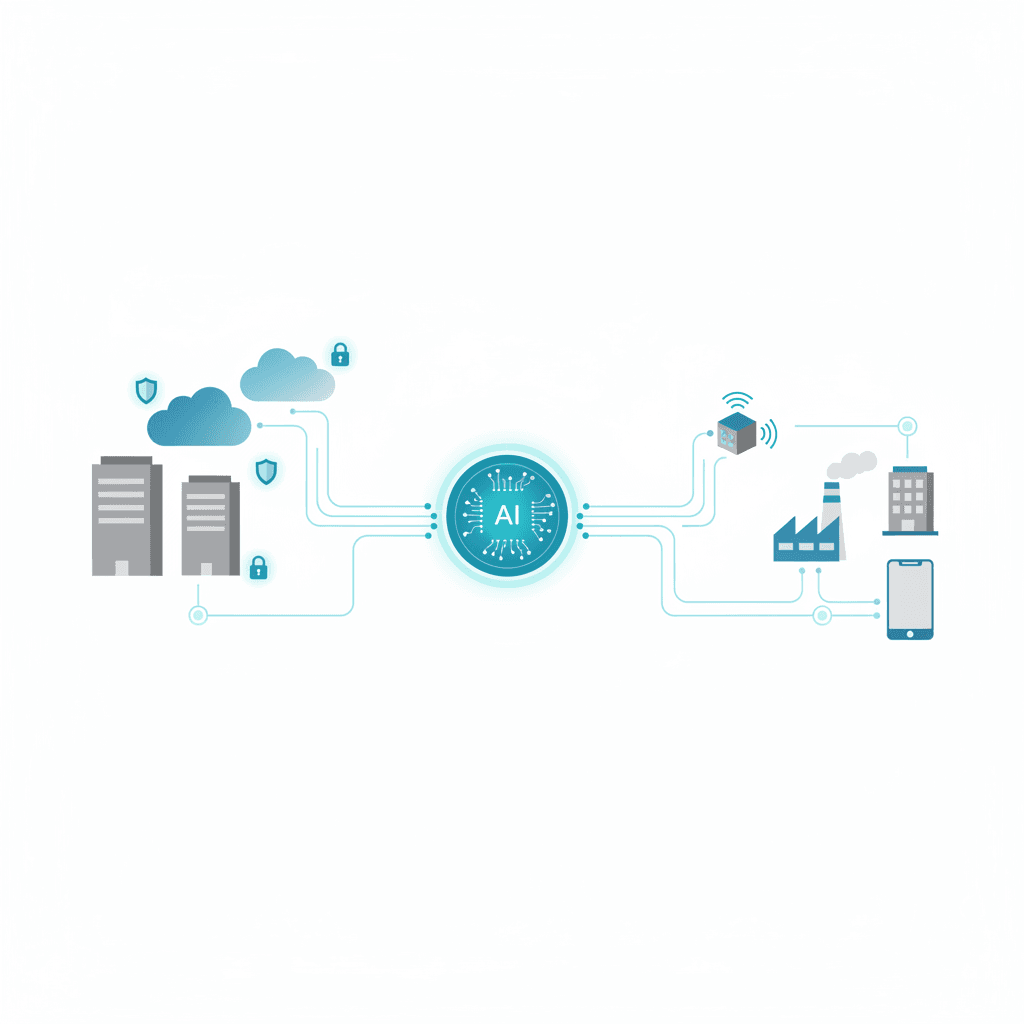
Why evidence matters: proof that infrastructure changes outcomes
Enterprises that invest in scalable AI infrastructure see faster time to value. For example, strategic cloud and vendor alliances expand capacity and reduce procurement friction. AP News reports that Anthropic committed to purchasing $30 billion of Azure compute capacity, which signals larger players’ focus on capacity planning and regional supply chains. Full story: AP News.
Expert perspectives
- Jensen Huang, CEO of NVIDIA, frames AI as a form of critical infrastructure. He said, “AI is now infrastructure, and this infrastructure, just like the internet, just like electricity, needs factories.” See NVIDIA blog.
- Industry analysts note that many AI projects stall before production. Consequently, teams must close the gap between experimentation and deployment to capture value. For example, BCG finds only 26 percent of companies have the capabilities to move beyond proofs of concept. Read BCG.
Concrete examples and outcomes
- NTT and tsuzumi 2: NTT released tsuzumi 2, a Japanese LLM that runs on a single GPU. As a result, organisations like Tokyo Online University can deploy models on premises or in private clouds. Details: NTT news release.
- Hardware advances: NVIDIA’s Grace Blackwell with NVLink promises large speed gains. Therefore inference latency and token economics improve for high throughput workloads. Background: Artificial Intelligence News.
Key takeaways
- Robust infrastructure reduces operational cost and latency. Thus it accelerates production rollouts.
- Hybrid and edge deployments lower data residency risk and cut inference cost in target regions.
- Because scaling involves people and process, invest in CI CD, monitoring, and governance early.
Related concepts: inference efficiency, data sovereignty, hybrid cloud, NVLink, RAG, AI delivery networks.
| Strategy | Cost | Scalability | Ease of implementation | Security | Typical use cases |
|---|---|---|---|---|---|
| Public cloud | Lower upfront, higher ongoing OpEx | Very high, elastic for peak demand | Easy to start, fast provisioning | Shared responsibility model, strong managed controls | Training scale, SaaS integrations, burst inference |
| Private cloud or on premises | High capital expenditure, lower long term OpEx | Moderate, constrained by local hardware | Complex setup and procurement | High control over data and residency | Regulated industries, sensitive data workloads |
| Hybrid cloud | Balanced CapEx and OpEx | High when integrated correctly | Moderate, requires orchestration tools | Mix of cloud controls and on premises controls | Gradual cloud migration, RAG with private data |
| Edge and distributed inference | Lower regional OpEx, hardware costs vary | Scales horizontally by site | Complex, needs device management | Strong for latency and data residency | Real time IoT, retail inference, low latency apps |
| Multi cloud federation | Variable costs, potential higher network fees | High but operationally complex | Complex, needs federation tooling | Depends on providers and governance | Vendor redundancy, geo resilience, regulatory diversity |
Key trade offs and recommendations:
- Prioritise inference efficiency because inference drives ongoing costs. Therefore optimise model size and batching.
- Choose hybrid or multi cloud when data sovereignty and latency are critical. This balances scalability with control.
- Invest in orchestration, CI CD, and observability early. Otherwise operational complexity will slow adoption.
Related keywords: edge computing, latency, inference, data sovereignty, hybrid cloud, NVLink, RAG.
CONCLUSION
Strong Enterprise AI infrastructure and deployment strategies determine whether AI delivers business value. In short, choose architectures that match your latency, sovereignty, and cost requirements. Hybrid and edge patterns balance control and scale. Public cloud accelerates experiments, while private clouds protect sensitive data. Therefore decision makers should map use cases to deployment patterns before investing heavily.
Because inference drives operational cost, optimise models and deployment for efficient inference. Invest in orchestration, CI CD, monitoring, and governance early. As a result, teams avoid the common trap where pilots stall before production. Also consider vendor alliances and regional capacity commitments when planning procurement and resilience.
AllosAI helps enterprises operationalise AI at scale. The platform provides enterprise grade external chatbot solutions, lead capture, CRM integration, and AI powered customer engagement tools. Visit the website to learn more at AllosAI. Try the platform at AllosAI Platform. Explore the knowledge hub at AllosAI Blog. Follow updates on X at Hey AllosAI.
Take the next step by aligning your infrastructure choices with clear business outcomes. Experiment quickly, but design for production from the start. Contact vendors and pilot partners with a focus on inference economics and data governance. Then scale confidently toward measurable ROI.
Frequently Asked Questions (FAQs)
What deployment model should my enterprise choose?
Start by mapping business outcomes and user needs. Because latency, data residency, and cost differ by use case, choose the model that fits those constraints. For real time apps pick edge or hybrid deployments. For heavy training or burst inference use public cloud. For regulated data prefer private cloud or on premises.
How can I reduce inference costs?
Optimise models with quantisation and pruning. Also batch requests and use server side caching. Consider single GPU models, like tsuzumi 2, for small to medium workloads. Finally evaluate cost per query alongside SLA needs.
How do I meet data sovereignty and compliance requirements?
Use regional inference nodes and private cloud for sensitive data. Encrypt data at rest and in transit. Additionally keep immutable snapshots and replication for auditability. Coordinate legal, security, and platform teams early.
What tools and processes speed production deployments?
Adopt CI CD for models, model registries, and observability. Use orchestration platforms such as Kubernetes. Also automate testing, canary releases, and rollback procedures.
How should we measure success?
Track latency, cost per query, accuracy, uptime, and business KPIs. Run pilot benchmarks and then measure real world ROI. Then iterate based on operational telemetry.