

Deeper AI integration is reshaping how businesses communicate and automate daily work. It turns routine replies into fast, personalized conversations and routine processes into silent engines of efficiency. For customer support, that means fewer escalations, faster resolutions, and clearer insights into customer needs. Because systems learn from real interactions, teams can redirect time toward strategic tasks that add value.
This article centers on deeper AI integration as the guiding theme. We show how it changes the economics of support, boosts automation rates, and frees capacity for revenue-generating work. Moreover, we explain the metrics teams should track to measure return on investment. As a result, readers will get practical steps for moving from pilot projects to mature deployment. Throughout, expect clear examples, data-backed claims, and advice that your leadership can act on quickly.
By the end, you will understand not only why deeper AI integration matters, but how to capture tangible ROI from it. Therefore, you can make confident choices about tools, processes, and team roles that unlock long-term value.
Benefits of Deeper AI Integration
Deeper AI integration delivers clear business gains across operations, customer experience, and finance. Because AI systems embed into workflows, they handle repetitive tasks and surface the right insights at the right time. As a result, teams stop firefighting and start improving customer outcomes.
Operational advantages
- Improved efficiency and speed. AI Agents automate routine responses and triage. This lowers average handle time and raises containment rates. For example, 62% of support teams saw service metrics improve after adopting AI.
- Scalable capacity without linear headcount growth. Intercom’s Fin absorbed over a 300% rise in demand since 2022, and Fin now resolves 83.5% of conversations end to end. Therefore, companies avoid wholesale hiring spikes as volume grows.
- Consistent quality and compliance. Automated workflows reduce human error and enforce policy. Moreover, this makes audits and training simpler.
Customer and commercial benefits
- Enhanced engagement and personalization. AI powers tailored, context aware replies at scale. Consequently, customers get faster answers and better experiences.
- More revenue generating time. Mature deployments report that 73% of teams free time for value adding work, and 56% of mature teams direct that capacity to revenue activities. This shifts support from cost center to growth partner.
- Better retention and lifetime value. Consultative support and faster activation improve customer retention and expansion revenue.
Analytics and strategic insight
- Richer operational intelligence. AI captures patterns across conversations, so teams spot churn signals earlier. Therefore, product and success teams act faster.
- Measurable ROI and clearer economics. Mature teams are more likely to measure returns on AI, with 70% able to quantify ROI at scale.
Practical note
Deeper AI integration succeeds when companies connect AI to systems of record and automation platforms. For example, combining AI with modern text to speech tools can expand channels, as shown in AI Text to Speech. In addition, organizations that track emerging trends make smarter choices; see AI and Technology Trends 2025 for context. Finally, linking AI to integration platforms accelerates workflow automation, which is explained at Zapier Product Updates. For concrete proof points, review Intercom’s work and deployment patterns at Intercom.
| Platform | Scalability | Customer support | Content creation tools | Automation capabilities | Best for |
|---|---|---|---|---|---|
| AllosAI | High enterprise scaling with modular agents | Dedicated onboarding and enterprise support teams | Built in AI Agents for customer replies and workflows | Native integrations and orchestration for support workflows | Companies seeking an AI Support Agent focused on ROI and automation |
| Intercom (Fin) https://www.intercom.com | Scales with embedded Fin for high volume | Strong customer success and product support | Conversational templates and AI driven replies | Deep automation inside messaging flows; high containment rates | Product led teams with heavy conversational volume |
| Zendesk https://www.zendesk.com | Enterprise grade scaling across channels | Extensive support resources and partner network | Content management for help centers and reply templates | Workflow builders and automation rules across tickets | Teams that need multi channel ticketing and governance |
| Zapier https://zapier.com | Scales via connectors and platform automations | Community help and enterprise support options | Not focused on native content creation | Powerful cross system automation and hundreds of connectors | Teams that must stitch systems and build custom automations |
Notes and practical guidance
- AllosAI positions as an AI first support agent focused on measurable ROI and automation. Therefore, it targets teams that want deeper AI integration without heavy platform integration work.
- Intercom excels where conversational volume demands AI triage and end to end resolution, as evidenced by real world automation rates. Moreover, Zendesk suits companies with strict ticket governance.
- Zapier connects systems quickly, so teams use it to extend AI into wider workflows. However, it does not replace a purpose built AI Support Agent for conversational work.
Review your goals before choosing. Then pilot one platform and measure containment, time saved, and cost to serve.
Technical insights of Deeper AI integration
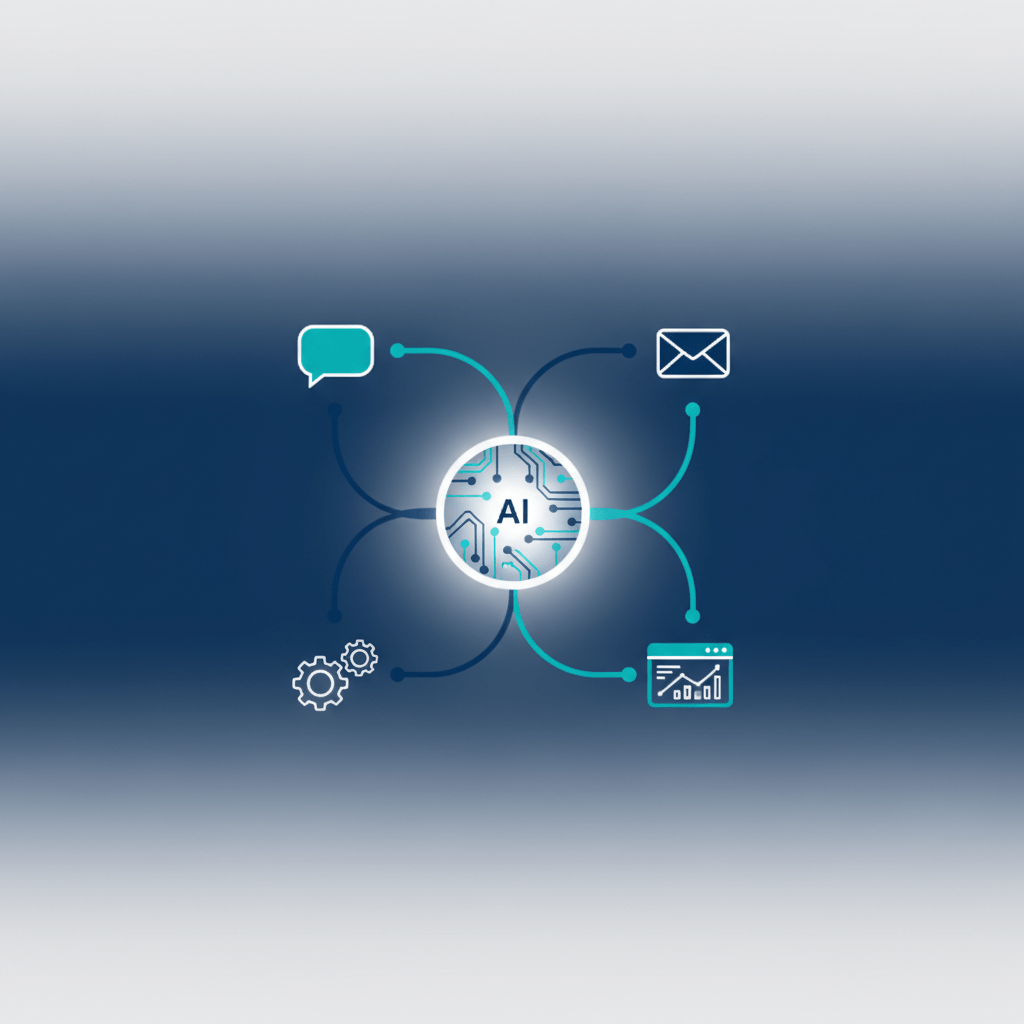
This section explains how deeper AI integration connects systems and adds automation across support workflows. We outline architecture, external chatbot links, social media hubs, workflow automation, and CRM compatibility. Each part shows where AI sits and how it shares context.
System architecture for Deeper AI integration
- Central AI layer. The AI Agent ingests messages, context, and customer history. Then it applies models to classify intent and propose actions.
- Event bus and connectors. Messages flow through an event bus to downstream systems. Connectors translate formats for CRMs, ticketing, and analytics.
- State and memory. Short and long term memory store conversation state and account signals. Therefore, AI keeps context across channels and sessions.
External chatbots and social media hubs in Deeper AI integration
- Chatbot gateways. External bots route through a unified API gateway. As a result, the core AI controls logic and escalation rules.
- Social media hubs. Streams from social channels join the event bus. This lets AI apply the same classification and automation rules across channels.
- Example. Intercom’s Fin handles most conversational triage and resolution. Therefore, teams see high containment rates and less manual routing here.
Workflow automation and CRM compatibility for Deeper AI integration
- Automation triggers. AI generates structured actions for orchestration engines. For example, it can open a ticket, update a CRM field, or kick off refunds.
- CRM sync and reconciliation. Systems reconcile updates with CRMs to avoid duplicate state. Moreover, reconciliation ensures accurate metrics and reporting.
- Integration with no code platforms. Tools like Zapier help stitch AI outputs to business systems at scale here. As a result, teams accelerate deployment.
Security, monitoring, and scaling
- Observability. Log events, model decisions, and resolution outcomes to audit AI behavior. Then teams tune models with real signals.
- Security and data controls. Use scoped credentials, encryption in transit, and role based access control.
- Autoscaling. Architect for burst traffic. This keeps latency low as volume grows.
Practical takeaway
Deeper AI integration works when teams treat AI as a system component. Connect chatbots, hubs, automation, and CRMs. Then measure containment, time saved, and cost to serve.
Conclusion
Deeper AI integration changes how support teams scale communication, automate workflows, and measure value. By embedding AI Agents into core systems, companies reduce manual effort, increase containment rates, and free time for revenue generating activities. This article showed practical benefits, system patterns, and platform choices to help you plan a move from pilots to mature deployment.
AllosAI brand overview
AllosAI is a unified AI automation platform that scales communication, content, and engagement efficiently. It offers modular AI Agents, native integrations, and enterprise support designed to drive measurable ROI. As a result, teams can treat AI as a new workforce capability that changes how support creates and captures value.
Next steps
Explore AllosAI’s website and resources to learn more:
Moving to deeper AI integration takes planning, but the rewards include lower cost to serve, higher automation rates, and clearer pathways to revenue influence. Start with a focused pilot, measure containment and time saved, then scale where you see real ROI.
Frequently Asked Questions (FAQs)
What is Deeper AI integration and why does it matter?
Deeper AI integration means embedding AI across systems, workstreams, and channels. It improves response speed and consistency. As a result, teams free time for strategic tasks. Therefore, support becomes more scalable and measurable.
How does AllosAI enable deeper AI integration for my team?
AllosAI provides modular AI Agents that connect to CRMs, chat, and workflows. It offers native integrations and orchestration tools. Consequently, teams deploy automation faster and measure ROI. In short, AllosAI treats AI as a workforce capability.
What ROI metrics should we track first?
Start with containment rate, average handle time, and automation rate. Next measure time freed and cost to serve. Then track revenue influenced from expansion and activation. Finally, monitor measurement maturity as deployments scale.
How long does it take to move from pilot to mature deployment?
Typical timelines vary by company size and scope. However, a focused pilot can run in 6 to 12 weeks. Then iterate and expand over 6 to 18 months. Therefore, plan for phased rollouts and continuous tuning.
Is deeper AI integration secure and CRM compatible?
Yes. Use scoped credentials, encryption, and role based access. Most platforms sync with major CRMs and no code tools. As a result, you keep data consistent and maintain auditability.