
AI Maturity as a Business Evolution Imperative
AI maturity is now a business evolution imperative, driving how companies adopt and scale intelligent systems. In practice, it measures how well organizations integrate AI into tools, processes, and culture. At low levels, teams experiment in silos. At higher levels, organizations deploy AI orchestration across workflows with governance and observability.
Assessing your AI maturity reveals gaps in integration, skills, and governance. Therefore, leaders can prioritize investments that deliver measurable advantages. For example, AI-powered workflows improve response times and drive revenue uplift when integrated with CRMs. However, without role-based permissions and audit trails, automation creates risk.
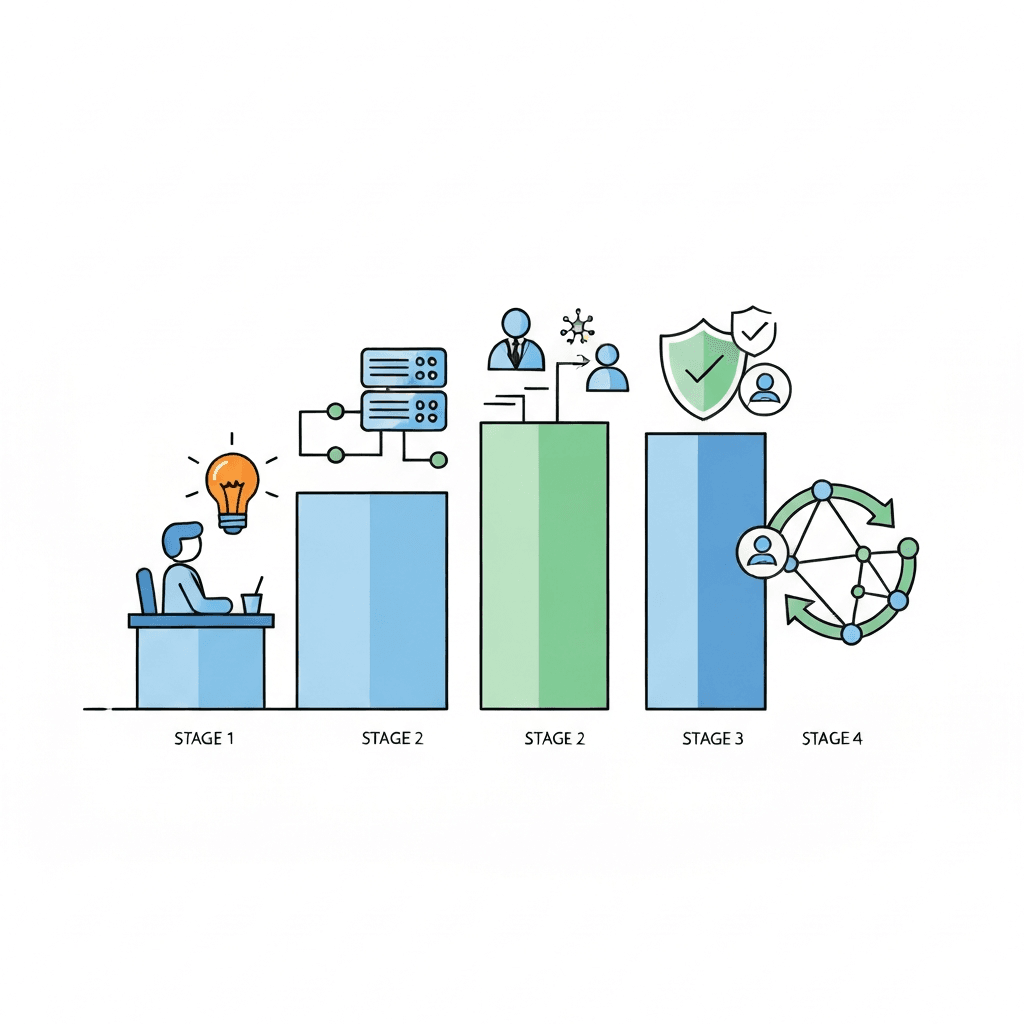
As a result, measuring maturity helps balance automation with human in the loop controls. This article maps four stages of AI maturity and shows when to combine autonomous agents with human oversight. You will learn practical steps for governance, prompt standardization, and dynamic AI orchestration. Read on to benchmark your organization and win competitive advantage through intentional AI transformation.
Understanding AI Maturity Components
AI maturity depends on four core components that work together. First, data governance ensures high quality, lineage, and access controls. It includes role based permissions, audit trails, and version history to support compliance and trust. Because poor data practices break automations, invest in metadata, observability, and access controls early.
Second, AI strategy aligns use cases with business value. Leaders must map workflows, define metrics, and prioritize low risk wins. Moreover, strategy covers AI orchestration, prompt standardization, and feedback loops that make models repeatable.
Third, technology infrastructure provides integration, APIs, and orchestration layers. It enables AI powered workflows and connects CRMs, ticketing systems, and analytics. For example, tools like Zapier integrate thousands of apps to simplify automation and orchestration. Therefore, a flexible integration layer reduces friction.
Fourth, cultural readiness drives adoption. Teams need AI fluency, training, and incentives. As a result, organizations close skill gaps and move from experimentation to scaled deployment. The research shows that 35 percent of enterprises cite AI skill gaps as a top barrier to adoption, and 78 percent struggle to integrate AI with existing systems. These facts underline the cultural and technical work required.
Key capabilities at a glance
- Data governance that includes lineage, audit trails, and access controls
- AI strategy with measurable goals, use case prioritization, and ROI criteria
- Technology infrastructure with APIs, integration layer, and observability
- Cultural readiness that includes training, feedback loops, and clear ownership
Measuring AI Maturity Effectively
You should measure AI maturity with clear gauges and regular reviews. Start with simple audits, because they reveal immediate gaps. Use scorecards for data readiness, model reliability, governance, and skills. Additionally, track time to value, failure rates, and human in the loop interventions.
Balance qualitative surveys with quantitative metrics. For example, monitor automation accuracy, percentage of workflows using AI, and audit log completeness. Moreover, link scores to business outcomes like customer response time and renewal risk.
AI Maturity in Practice
Most companies know they should be doing more with AI. What is harder to define is what more actually means in practice. Therefore, use the four components above to build a roadmap. Explore related thinking on trends and hype at AI and Technology Trends 2025 and learn when human agents remain foundational at Why Human Agents Remain Foundational. Also read cautionary signals at AI Hype Index Signals. Finally, treat stage four not as an endpoint, but as a foundation for continuous improvement.
| Model | Typical stages | Assessment focus areas | Typical outcomes by stage |
|---|---|---|---|
| Gartner | Ad hoc; Opportunistic; Systematic; Transformational | AI strategy; data governance; integration layer; risk and compliance; talent | Stage 1: fragmented pilots and experiments. Stage 2: AI in core systems and repeatable workflows. Stage 3: formal governance, role based permissions, audit trails. Stage 4: adaptive AI orchestration and measurable ROI. |
| Forrester | Ad hoc; Coordinated; Operationalized; Strategic | Use case value; model performance; observability; change management | Stage 1: isolated proofs of concept. Stage 2: coordinated deployments and improved accuracy. Stage 3: governance, monitoring, and scale. Stage 4: AI driven processes and business outcomes. |
| Deloitte | Awareness; Experimentation; Scaling; Institutionalized | Data readiness; technology infrastructure; operating model; talent and change | Stage 1: awareness and pilot projects. Stage 2: integrated tools and APIs. Stage 3: standardized processes and controls. Stage 4: institutionalized AI with continuous improvement. |
How to use this comparison
- First, map your organization to the closest model stage. Then, identify gaps in data governance and technology infrastructure.
- Additionally, prioritize quick wins that align with AI strategy and customer impact.
- Finally, track metrics such as time to value, automation accuracy, and audit log completeness.
Benefits and Challenges of AI Maturity
As organizations climb AI maturity, they unlock concrete benefits. First, mature AI improves decision making through better data and models. Second, automation efficiency increases across repetitive workflows. Third, teams gain an innovation culture that tests and scales ideas rapidly. Quote: AI orchestration turns AI from a collection of tools into operational infrastructure. Therefore, maturity delivers measurable business outcomes when paired with governance and observability.
Benefits by maturity level
- Early stages: Faster prototyping and clearer use case discovery. Teams experiment cheaply and learn quickly.
- Mid stages: Automation efficiency improves as AI moves into core systems. Repetitive tasks decline and response times shorten.
- Advanced stages: Improved decision making and predictive insights drive revenue and retention. Organizations achieve dynamic AI orchestration across workflows.
- Continuous stage: Innovation culture becomes the norm. Teams iterate with feedback loops and prompt standardization.
Practical examples
- A support team reduces average first response time by automating triage and routing. As a result, customer satisfaction rises.
- A RevOps group uses AI to prioritize leads and reduce churn risk. Consequently, renewal rates improve.
- A product team applies sentiment analysis to surface feature requests. Thus, roadmap decisions become data driven.
Common challenges to plan for
- Data quality issues: Poor data breaks models and automations. Therefore, invest early in lineage, observability, and cleaning.
- Skill gaps: About 35 percent of enterprises cite AI skill gaps as a top barrier to adoption. Consequently, hire or upskill to close the gap.
- Integration friction: Many organizations struggle to connect AI with legacy systems. As a result, 78 percent report integration challenges.
- Change resistance: Teams resist new workflows without clear incentives and training. Therefore, lead with use case wins and clear ownership.
Mitigation checklist
- Start with small, measurable pilots tied to business metrics.
- Build role based permissions, audit trails, and version history for trust.
- Create training programs that increase AI fluency and ownership.
In short, AI maturity delivers automation efficiency, better decisions, and an innovation culture. However, leaders must address data, skills, and integration to realize those gains.
Conclusion
Advancing AI maturity transforms how organizations operate and compete. It moves AI from pilots to operational infrastructure. Mature AI improves decision making, reduces costs, and creates an innovation culture. Organizations gain automation efficiency and faster response times. Therefore, teams can scale outcomes without proportional headcount increases.
AllosAI is a unified AI automation platform that combines chatbot systems with social media content automation. It reduces operational costs by automating routine tasks. As a result, support teams improve response times and scale audience engagement. Moreover, AllosAI centralizes workflows and governance so teams maintain control and auditability. Try the platform at AllosAI and start building automations on the app at AllosAI App. Additionally, read practical guides and updates at AllosAI Blog and follow news at Hey Allos.
Take action now. Benchmark your AI maturity and prioritize measurable wins. Sign up, run a pilot, and measure time to value. Finally, treat AI maturity as continuous improvement. It will sustain long term competitive advantage.
Frequently Asked Questions (FAQs)
What is AI maturity?
AI maturity describes how well an organization integrates AI into processes, tools, and culture. At low levels, teams run isolated experiments. At higher levels, AI orchestration coordinates models, automations, and governance across workflows. Therefore, maturity covers data governance, technology infrastructure, and cultural readiness. In short, it is about fit, not simply climbing a ladder.
Why should my organization assess AI maturity?
Assessing maturity reveals gaps and opportunities. For example, it highlights integration friction and skill shortages. Because of this, leaders can prioritize projects that deliver quick wins and measurable ROI. Additionally, assessment helps balance autonomous agents with human in the loop controls. As a result, you reduce risk and speed time to value.
How do we measure AI maturity?
Start with a simple scorecard that covers data readiness, model reliability, governance, and skills. Track quantitative metrics such as percentage of workflows using AI, automation accuracy, time to value, and audit log completeness. Moreover, supplement numbers with qualitative surveys on adoption and change readiness. Next, run regular audits and update your roadmap based on outcomes.
What challenges will we face when improving AI maturity?
Common barriers include poor data quality, skill gaps, and integration with legacy systems. In fact, about 35 percent of enterprises cite AI skill gaps as a top barrier, and 78 percent report integration challenges. Change resistance and unclear ownership also slow progress. Therefore, plan for training, clear roles, and governance to mitigate these issues.
Where should we start to advance AI maturity?
Begin with a focused pilot tied to a business metric. Choose a use case that is low risk and high value. Then, implement role based permissions, audit trails, and feedback loops. Finally, scale systems only after you have repeatable results and observable metrics. Continuously iterate, because stage four is a foundation for continuous improvement.