

In the ever-evolving world of technology, one innovation stands out: drone food delivery in Finland. Imagine ordering your favorite meal and having it arrive at your doorstep via drone, reducing wait times and minimizing human contact. This futuristic concept has already taken flight in Finland, revolutionizing how people receive their meals.
As companies like Manna push boundaries by deploying drones in cities like Espoo, the efficiency and potential cost-savings promise a new era for food delivery systems. With regulatory permissions in place, these automated aerial wonders aim to transform not just the Finnish skies, but eventually the global food delivery landscape.
How drone food delivery in Finland is transforming the food delivery landscape
Drone food delivery in Finland is reshaping last mile logistics and urban service models. Companies such as Manna and local partners have moved from pilots to live operations in Espoo. As a result, delivery speed and route efficiency have improved. However, this change depends on technology, regulation, and consumer trust.
Key technological advancements
- Lightweight yet robust drones now carry about 4.4 pounds, which covers most meal orders. This increases delivery flexibility.
- Advanced navigation uses LiDAR maps and planned flight itineraries reviewed by remote operators. Therefore operators maintain safe routes across suburbs.
- Battery swap systems reduce downtime because drones leave with a full charge. Redundancy exists at multiple levels, and a parachute acts as a last resort.
Regulatory environment and safety measures
- Operators secured permits before launching pilots in February, and full operations followed after approvals. For background, see TechCrunch.
- Regulators require certified equipment and approved delivery bags. As a result, icing and harsh weather remain constraints, and orders revert to couriers when needed.
- Mission Control often sits outside the country, which means local teams still manage hands-on tasks at shared launchpads.
Consumer adoption and local operations
- Local customers receive notifications when drone delivery is available, boosting convenience and choice. For example, Wolt detailed early trials and the shared launchpad model here.
- Early unit economics look promising because drone deliveries can reduce costs compared to couriers. Huuva estimates suggest large potential savings.
- Businesses can integrate automation tools into operations; tools like AI Vision, AI Code, and AI Bots are useful for route planning and fleet monitoring (AllosAI).
Taken together, technological readiness, sensible regulation, and rising consumer trust are driving meaningful change. Therefore drone food delivery in Finland offers lessons for broader business automation and last mile innovation.
Evidence and examples of drone food delivery in Finland
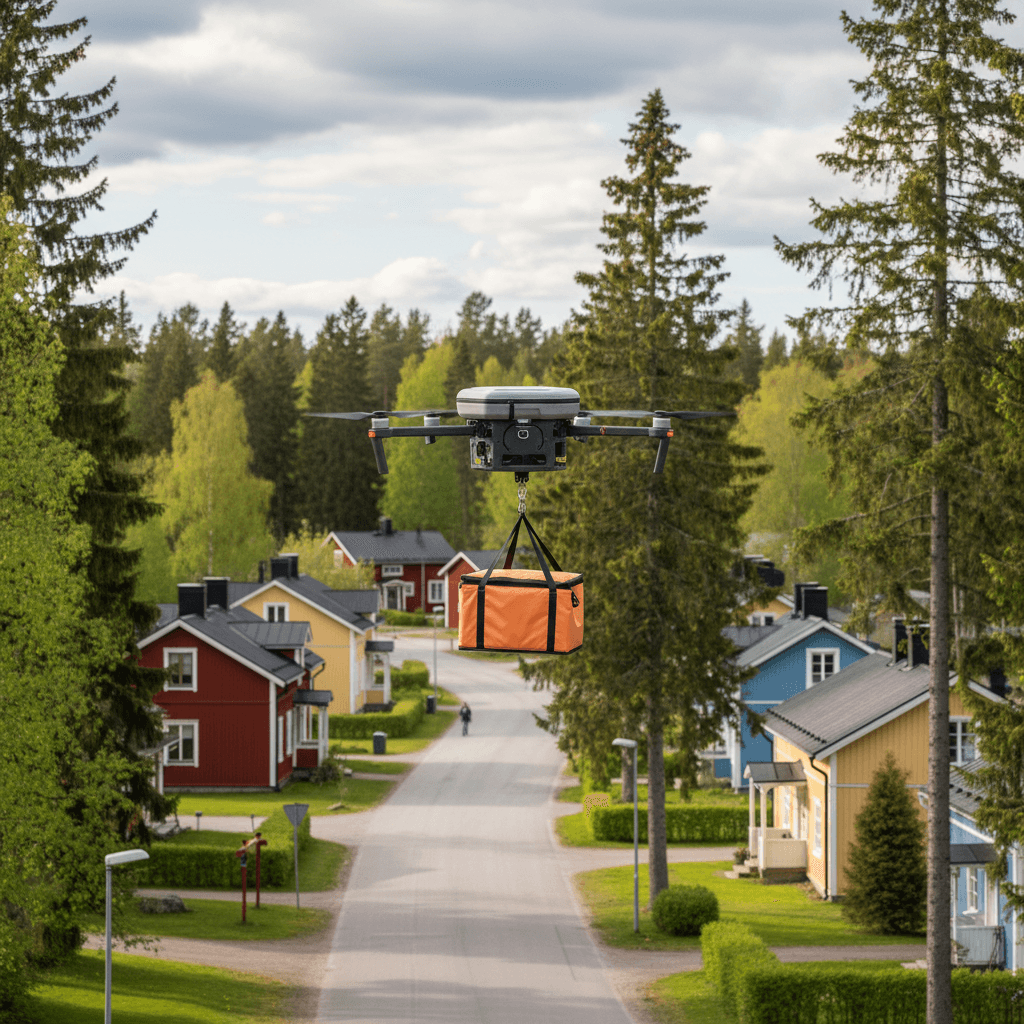
Several concrete pilots and early operations show how drone food delivery in Finland moves from concept to reality. For instance, Manna began operations after securing permits and ran a pilot in February. As a result, drones have been fully operational in Espoo for the last two months. Manna previously completed more than 50,000 deliveries in Dublin, which demonstrates real-world scale and learning.
Notable examples and local setups
- Manna in Espoo: Local staff handle double-digit deliveries a day. Launchpad operations share space with Wolt Market, and delivery workers use e-scooters to bring food in heat bags to drone operators. Therefore teams place orders on scales and balance weight before bagging.
- Huuva trials: Huuva reports promising unit economics. For example, Huuva’s team estimates regular courier deliveries cost about €5-6 each, while drone deliveries could fall near €1 (about $1.16). This comparison highlights potential long-term savings.
- Cross-border lessons: Manna’s experience in Dublin informs Finnish operations. Mission Control sits in Ireland, where operators review LiDAR maps and plan itineraries. Because of this setup, Finnish teams focus on local handling and compliance.
Successes and measurable impacts
- Speed and convenience increased in served neighborhoods. Consequently residents saw shorter wait times and fewer street-level delivery trips.
- Operational resilience improved thanks to systematic battery swaps and redundancy at multiple levels. In addition, a parachute provides an extra safety layer.
Challenges and limits
- Weather constraints remain real. Icing poses a special problem, and teams route orders back to couriers in unsuitable conditions. As Makar Nalimov noted, using de-icing chemicals is not feasible when transporting food.
- Payload limitations persist because each drone carries around 4.4 pounds, although operators can send two drones for larger or multiple orders.
Community impact and lessons for businesses
- Local economies benefit when launchpads connect grocery partners and restaurants. For example, the shared launchpad with Wolt Market created efficient handoffs between e-scooter couriers and drone operators.
- Businesses can adopt automation tools to improve routing and monitoring. Tools such as AI Vision, AI Code, and AI Bots help with fleet management and route optimization.
Taken together, pilots in Espoo show clear successes and real limits. Therefore drone food delivery in Finland provides practical lessons for broader last-mile automation.
| Company | Service areas | Delivery speed | Types of food delivered | Unique features |
|---|---|---|---|---|
| Manna | Espoo (Finland); prior operations in Dublin | Often faster for short hops; sub-20-minute local flights common | Hot meals, restaurant orders, small grocery items | Payload ~4.4 lb; can dispatch two drones; Mission Control in Ireland; parachute and battery-swap redundancy; shared launchpad with Wolt Market |
| Huuva | Pilot areas in Finland and Nordics | Short-range hops with focus on cost efficiency | Meals and light grocery items | Strong unit-economics focus; estimates suggest drone delivery near €1; testing cost models |
| Wolt Market (partner) | Espoo launchpad and nearby neighborhoods | Speeds up last mile when drones are available | Grocery and convenience items; heat-bagged food | Launchpad partner; e-scooter handoffs to drone operators; integrates with Wolt marketplace |
Conclusion
Drone food delivery in Finland marks a pivotal shift in last mile logistics. It cuts wait times, reduces street-level trips, and opens new unit-economics paths for operators. However, weather limits and payload constraints remain real challenges that teams must manage. Nevertheless, pilots in Espoo show clear promise and valuable operational learning for wider rollout.
AllosAI plays a supporting role in this transition. As an advanced AI automation platform, AllosAI helps modern businesses create intelligent content, automate workflows, and improve customer engagement. For details visit the website: AllosAI Website. To try the platform directly, go to the app: AllosAI App. You can also read guides and case studies on the blog: AllosAI Blog.
Looking ahead, drone food delivery will integrate with smarter supply chains and AI driven operations. Therefore companies should invest in data systems and robust automation to scale safely. In addition, strong collaboration among regulators, operators, and communities will prove essential. Follow updates from AllosAI on X: AllosAI on X. Overall, Finland’s pilots offer a practical roadmap for the future of last-mile innovation.
Frequently Asked Questions (FAQs)
Is drone food delivery legal in Finland?
Yes. Operators must secure permits before flights. For example, Manna began operations only after regulators approved the pilot. In practice, flights run under strict conditions. Therefore companies follow safety checks and certified equipment rules.
How safe are drones delivering food?
Drones use redundancy and batteries are swapped regularly. They include parachutes as last resorts. For instance, operators review LiDAR maps and planned itineraries. However icing and extreme weather remain risks. In those cases orders revert to couriers.
What can drones carry and how fast are they?
Typical payloads are about 4.4 pounds. Operators can dispatch two drones for larger orders. As a result, most local flights are under 20 minutes. This speed reduces street-level traffic and shortens customer wait times.
Do drone deliveries save money?
Early estimates suggest yes. Huuva estimates drone deliveries could cost near €1 each. By comparison, traditional courier costs are about €5-6. Therefore drones show strong unit-economics potential when scaled.
How do drones affect local communities and businesses?
They reduce delivery vehicle trips and speed up service. In Espoo launchpads link grocery partners and restaurants. In addition local staff handle handoffs and quality checks. Thus communities see operational benefits, though careful regulation remains essential.