


Protecting business search and content accuracy from AI web search risks
Imagine a legal brief or financial forecast built on a wrong web answer. AI web search risks and data accuracy in business matter more than ever. GenAI can surface fast but flawed results. However, many teams treat AI outputs as final, and that creates compliance and legal hazards. Therefore, business leaders must know where AI helps and where it can mislead.
This article explains common risks, from overconfident answers to poor citations. It shows how inaccuracies affect finance, legal, and customer operations. Moreover, it outlines practical steps like human-in-the-loop checks, prompt specificity, and verification workflows. As a result, readers will learn how to balance trust and accuracy, reduce shadow IT issues, and protect sensitive decisions. The tone here is cautious and governance focused, aiming to equip teams with clear steps and policies. Read on to see real test findings and governance tactics.
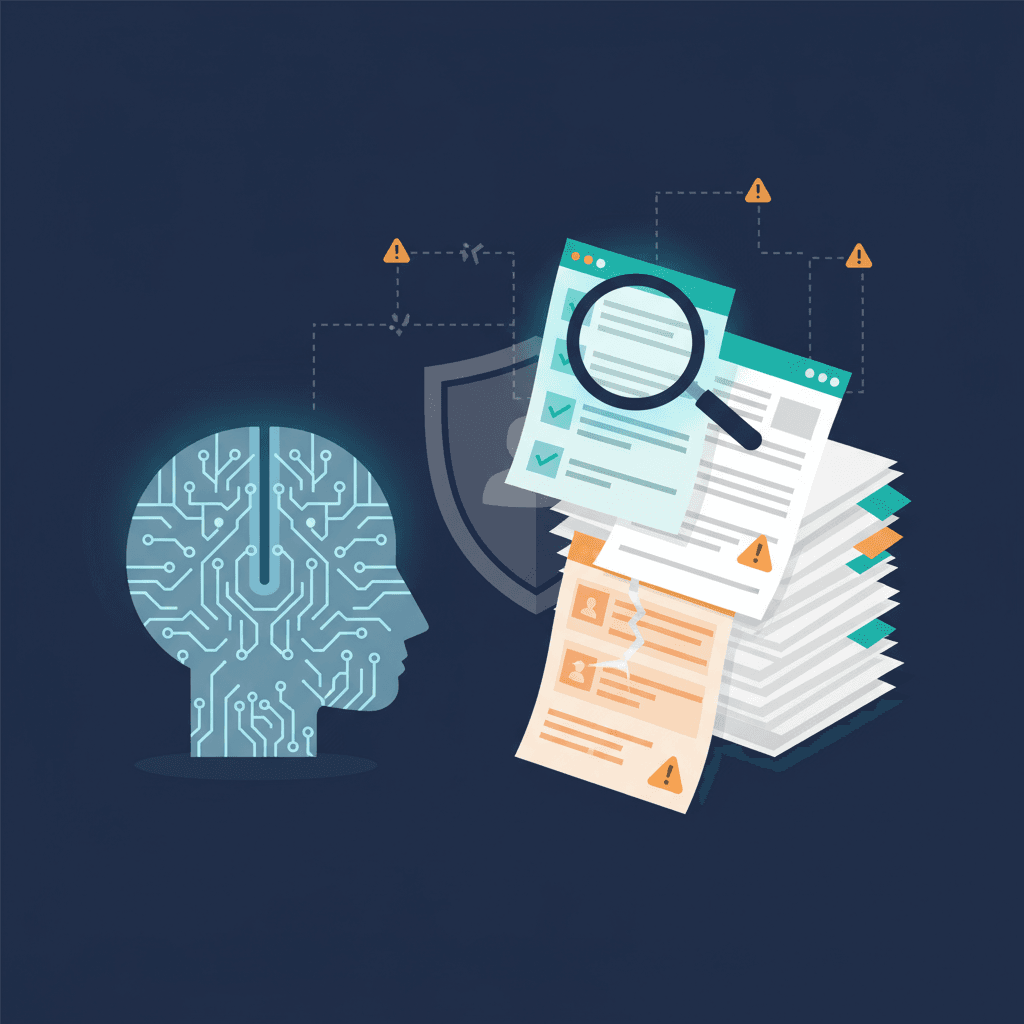
AI web search risks and data accuracy in business: core pitfalls
AI web search risks and data accuracy in business begin with overconfidence. Many tools present single, polished answers quickly. However, speed does not equal truth. For example, Which? found notable errors across major assistants in a 40-question test. The study showed varying accuracy and risky consumer advice. See the full report at Which?
Key pitfalls include
- Misinformation and hallucinations that invent facts
- Poor or missing citations that hide weak sources
- Conflicting answers across AI providers that cause confusion
- Overconfident phrasing that masks uncertainty
AI data reliability: bias, sources and citations
AI data reliability suffers when training data is biased or stale. As a result, models may repeat systemic errors. Moreover, some tools link to premium services instead of official sources. For instance, incorrect tax guidance can steer users away from HMRC materials. Verify tax limits at the official site: GOV.UK
Common reliability issues
- Regional legal differences ignored, causing statutory mistakes
- Source transparency gaps that hinder verification
- Dataset bias that skews recommendations toward popular voices
Business risks with AI: operational, legal and financial impact
Businesses face real risks when they treat AI output as final. Incorrect legal or financial advice can cause compliance breaches. Therefore, companies can face regulatory fines, reputational damage, and poor decisions. In one case, AI outputs suggested withholding payment in a builder dispute. Read context and examples at The Guardian
Accuracy in AI web search: mitigation and verification
To reduce risks, implement human-in-the-loop reviews. Also, create verification workflows and require source citations. Train staff on prompt specificity and on when to escalate issues. Finally, monitor outputs across providers and update governance regularly. These steps make AI tools useful and safer for business decisions.
| Risk | Description | Potential Impact on Business | Mitigation Strategy |
|---|---|---|---|
| Data inaccuracies and hallucinations | AI may invent facts or return wrong numbers. | Misguided decisions that cause financial loss. | Verify facts with primary sources and add human review. |
| Bias and fairness problems | Models reflect biased training data and amplify trends. | Discrimination, legal exposure and reputational harm. | Audit models for bias and use diverse training data. |
| Source opacity and weak citations | Outputs lack clear or reliable sourcing. | Hard to validate claims and prove compliance. | Require source disclosure and link to official references. |
| Regional and legal nuance errors | Systems ignore jurisdictional differences in law. | Incorrect legal advice and regulatory breaches. | Create locality checks and escalate to legal teams. |
| Overconfident advice and liability | Polished answers hide uncertainty and limits. | Operational hazards and poor stakeholder trust. | Add uncertainty indicators and human-in-the-loop checks. |
| Security and data leakage | Prompts or responses expose sensitive data. | Data breaches and compliance violations. | Limit data in prompts and enforce access controls. |
Payoff of managing AI web search risks and data accuracy in business
Managing AI web search risks and data accuracy in business delivers measurable returns. When teams enforce verification and governance, they avoid costly errors and regulatory fines. Moreover, clear processes speed decisions and improve stakeholder confidence.
Key benefits include:
- Better decisions: Verified data leads to faster, more accurate strategic choices. Therefore, teams reduce costly missteps and align actions with evidence.
- Customer trust: Transparent sourcing and fewer mistakes increase customer loyalty. As a result, brands build stronger reputations and repeat business.
- Compliance protection: Rigorous checks reduce legal exposure and audit risk. Consequently, legal teams face fewer surprises during reviews.
- Operational efficiency: Fewer rework cycles and clearer workflows save time. Moreover, staff focus shifts from firefighting to higher value tasks.
- Competitive advantage: Reliable insights let teams move faster than rivals. In addition, leadership can pursue bolder initiatives with confidence.
Realistic scenarios:
- A finance team avoided a £250,000 forecasting error because a human reviewer caught a hallucinated figure. As a result, the company avoided a bad investment and protected margins.
- Customer support used AI answers but required source links and legal sign-off for claims. Therefore, complaints fell and Net Promoter Score improved over three quarters.
Investing in governance has an upfront cost but a fast payoff. Consequently, businesses that manage AI web search risks gain trust, agility, and resilience.
Conclusion
AI web search risks and data accuracy in business demand constant vigilance. Fast AI answers can be wrong, biased, or poorly sourced. Therefore, governance, human review, and verification workflows remain essential. Businesses must balance speed with accuracy to avoid legal and financial harm.
Emp0’s AllosAI platform provides tools to reduce these hazards. It automates verification, enforces source tracking, and supports human-in-the-loop reviews. Moreover, it supports compliance reporting and audit readiness. As a result, teams gain clearer audit trails, safer automation, and better customer engagement.
For example, a verified-source workflow prevented a misapplied tax rule in a finance team. That change saved time and avoided regulatory exposure. Likewise, customer teams using trusted AI responses reduced escalations.
Take action: explore AllosAI to see how governance meets AI efficiency. Visit AllosAI for platform details, try the application at AllosAI App, and read best practices on the blog at AllosAI Blog. Implementing strong controls around AI web search protects decisions, customers, and reputation. Start by auditing your AI workflows and integrating solutions like AllosAI today.
Frequently Asked Questions (FAQs)
What are the main risks of AI web search risks and data accuracy in business?
Primarily, misinformation, bias, weak citations, and data leakage. These can cause bad decisions and compliance breaches.
How should teams verify AI outputs?
Use primary sources and human-in-the-loop reviews. Also require clear citations and cross-check answers across providers.
When should I escalate an AI result to experts?
Escalate high-risk topics like legal, tax, and finance. If answers lack sources or conflict, ask legal or compliance teams.
Will governance slow innovation?
Not necessarily. Verified workflows reduce rework and speed confident decisions. Moreover, they improve customer trust and reduce costs.
How do we start improving accuracy?
Audit AI workflows, add verification gates, and run small pilots. Then measure error rates and refine prompts and policies. For more guidance, consult governance teams and trusted vendors today.