

AI for Go-to-Market (GTM) teams and automation integrations are reshaping how companies find, engage, and win customers. Today this shift matters because speed, personalization, and scale define competitive advantage. Smart automations route leads, summarize calls, and suggest next best actions. Meanwhile AI agents can handle routine tickets and free reps for strategic work. As a result teams reduce manual drudgery, cut response times, and boost close rates.
However embedding AI demands clear goals, clean data, and careful integration planning. Fortunately many platforms now offer pre-built connectors and low-code automation templates. But teams must also measure total cost of ownership and ongoing maintenance. In this guide we map practical AI use cases for marketing, sales, and service. You will find actionable steps, integration patterns, and vendor trade-offs to evaluate.
Read on to discover where to start, because the best AI begins with a real problem. Start small, iterate fast, and measure impact.
How AI for Go-to-Market (GTM) teams and automation integrations Are Revolutionizing Sales and Marketing
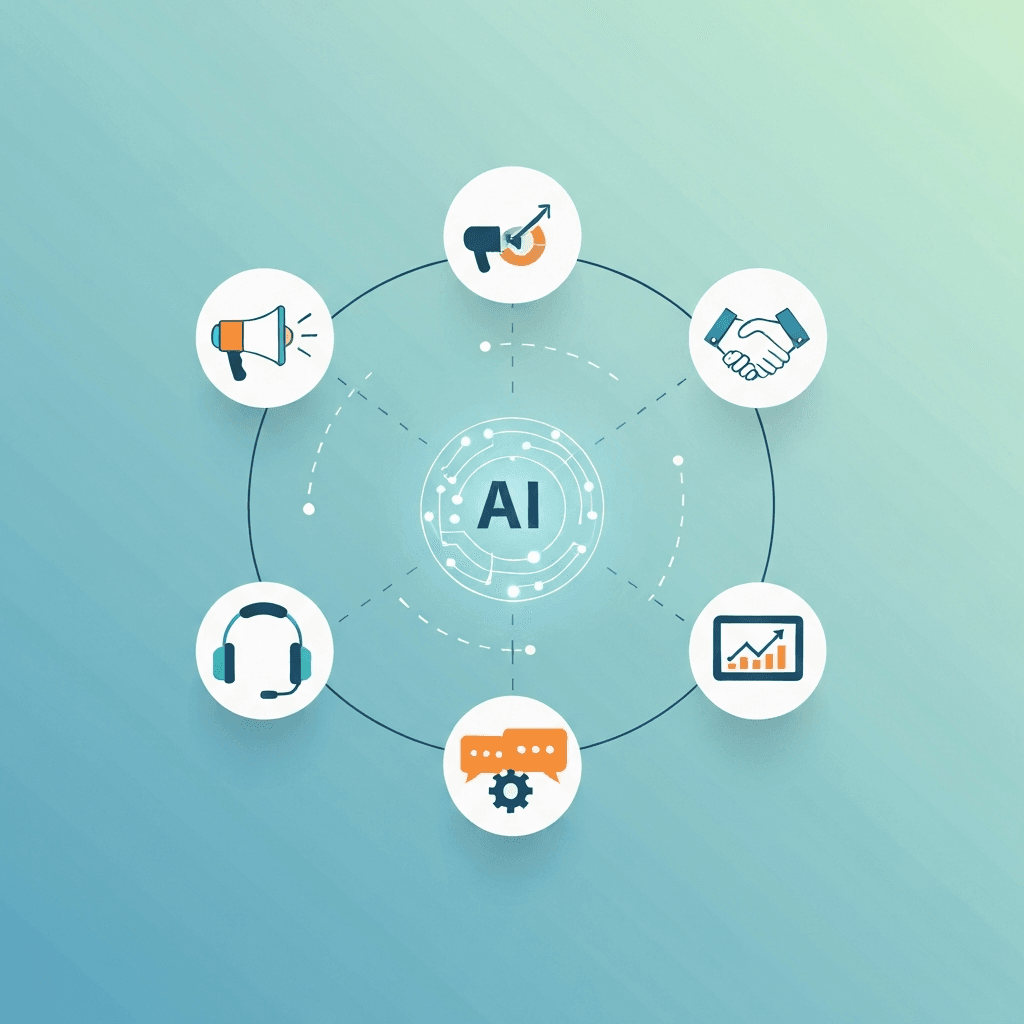
AI for Go-to-Market (GTM) teams and automation integrations accelerate outcomes by turning routine work into measurable motion. Teams gain faster lead response and clearer handoffs. As a result sales and marketing move from manual tasks to strategic actions. Meanwhile service teams resolve tickets faster, which improves customer satisfaction.
Key benefits at a glance
- Efficiency gains because AI automates repetitive tasks. For example, AI routes leads, scores prospects, and fills CRM fields automatically.
- Faster time to value since automations act in real time. Therefore reps reach engaged buyers while interest is high.
- Smarter decision making through predictive scoring and conversation intelligence. These tools analyze signals and recommend next best actions.
- Scalable personalization that keeps outreach relevant at volume. Consequently team messages feel tailored without manual work.
- Support automation that reduces ticket load and resolution time. For instance, AI support agents can resolve routine tickets, while humans handle complex cases. See AI Support Agent for an example.
- Integration breadth for connecting apps and AI tools. Zapier highlights large-scale AI connectivity.
- Flexible open-source options for custom workflows. In contrast, n8n offers a developer-focused node library.
Beyond speed and scale, AI improves alignment across GTM functions. Marketing can feed higher-quality leads to sales. Sales can share conversation insights with service teams. As a result the whole funnel tightens, and teams measure impact more clearly. However teams must still plan for clean data and integration costs. Therefore start with one high-impact use case, test quickly, and then expand iteratively.
| Aspect | Traditional GTM teams | AI-powered GTM teams | Resulting impact |
|---|---|---|---|
| Processes | Manual workflows and siloed tools. Reps do repetitive tasks. | Automated workflows, unified data flow, AI agents handle routine tasks. | Frees reps for strategy and shortens handoffs. |
| Speed | Slow lead response and batch processes. Follow-ups often delayed. | Real-time routing and instant lead scoring. Automations act immediately. | Captures buyer interest and shortens sales cycles. |
| Cost | High labor costs and hidden integration expenses. Scaling means more headcount. | Lower per-interaction costs after implementation. Requires initial investment. | Improves ROI long term, but plan total cost of ownership. |
| Accuracy | Manual data errors and inconsistent qualification. Forecasts often noisy. | Predictive scoring, automated data enrichment, conversation intelligence. | Raises targeting accuracy and forecast reliability. |
| Scalability | Scaling needs more people and manual processes. Personalization breaks down. | Models and automations scale outreach while keeping personalization. | Enables personalized outreach at volume with less headcount. |
AI for Go-to-Market (GTM) teams and automation integrations: Practical Use Cases and Integration Patterns
Automation integrations can reduce friction across the GTM stack. They connect CRM, marketing platforms, chat, form tools, and analytics so data flows without manual copying. As a result teams get accurate signals faster and act on them reliably.
Common GTM automation use cases
- Lead generation and enrichment. Automations capture leads from forms, landing pages, and chat. Then AI enriches records with firmographic and intent data. This reduces qualification time and improves targeting.
- Lead scoring and routing. AI scores leads using behavior, firmographics, and engagement. Therefore high-value leads route instantly to reps and low-value leads enter nurture sequences.
- Personalized outreach at scale. Automations merge AI-generated messaging with CRM data. Consequently emails and sequences feel tailored and maintain high throughput.
- Meeting scheduling and follow-ups. Integrations sync calendars, confirm meetings, and trigger follow-up tasks. As a result no-interest windows are shortened and show rates rise.
- Customer support automation. AI support agents answer common tickets, summarize conversations, and escalate complex issues to humans. For example see AI Support Agent.
- Ticket routing and classification. AI classifies ticket intent and routes to the right team. Therefore resolution times drop and agents focus on higher-value work.
- Content scheduling and replication. Automations publish and schedule content across channels, then feed performance metrics back into content systems. This streamlines campaign execution and measurement.
- Feedback loop for product and sales. Integrations aggregate survey feedback, call recaps, and NPS data into analytics. Consequently teams close the loop faster and prioritize product fixes.
Integration patterns to adopt
- Event driven syncs. Use webhooks and event streams for real-time actions. Therefore lead response happens while interest is fresh.
- Batch enrichment jobs. Run scheduled enrichment for large data sets to keep records accurate without blocking workflows.
- API-first connectors. Choose platforms with robust APIs so integrations remain flexible as needs evolve.
- Low-code automation templates. Start from templates to accelerate time to value, then customize. Zapier highlights many AI-ready automation templates.
- Self-hosted nodes for control. If privacy or customization is critical, consider open-source options like n8n to build custom nodes.
How integrations improve outcomes
Automations reduce manual work and speed responses, which lifts conversion rates and customer satisfaction. They also improve data quality and forecasting accuracy by removing human error. As a result teams spend more time on strategy and less on repetitive tasks. However teams must plan for data governance, monitoring, and ongoing maintenance to protect ROI. Therefore identify one high-value automation, measure the impact, and scale what works.
Conclusion
AI for Go-to-Market (GTM) teams and automation integrations deliver measurable benefits across the funnel. Teams gain speed because automations act in real time. They gain efficiency because AI removes repetitive work. As a result reps focus on strategy, and customers get faster, more relevant responses. Moreover predictive insights improve targeting and forecasting, which increases win rates and revenue.
AllosAI as a unified AI automation platform replaces first-line support and social media teams without increasing headcount. It runs AI agents that handle routine tickets, publish and schedule social content, and surface insights for human teams. As a result companies lower costs while maintaining high responsiveness and personalization. To try AllosAI visit the app at the AllosAI app, read practical guides at the AllosAI blog, or follow updates at AllosAI on X. Start with one high-impact use case, measure results, and scale what works.
Frequently Asked Questions (FAQs)
What does AI for Go-to-Market (GTM) teams and automation integrations actually mean?
AI for Go-to-Market teams and automation integrations means using machine learning and automation to improve marketing, sales, and support. It ties data, workflows, and AI agents into a single loop. As a result teams automate repetitive tasks and surface insights faster. Therefore businesses respond to buyers more quickly and more accurately.
How do I start implementing AI and automations for my GTM stack?
Start with one clear problem, not the technology. For example, pick lead routing, ticket deflection, or content scheduling. Then map the data sources and touchpoints involved. Next build a small automation or pilot using a low-code template. Measure outcomes and iterate. Finally scale the work that shows impact.
What data and infrastructure do I need to succeed?
You need clean CRM records and reliable event data. Also ensure APIs and webhooks connect your systems. For privacy, add proper access controls and retention rules. In practice, prioritize data hygiene and enrichment early. Because good AI depends on accurate, timely data.
Which integration platform should I choose: Zapier, n8n, or custom APIs?
Choose based on team skills and speed to value. Zapier gives fast deployment with thousands of pre-built integrations. Meanwhile n8n suits teams that need custom control and self-hosting. Custom APIs offer the most flexibility but cost more to build. Therefore weigh time, cost, and maintenance before deciding.
How do I measure ROI and manage ongoing costs?
Define metrics before launch. Measure response time, conversion rate, ticket volume, and cost per interaction. Also track model drift and integration failures. As a result you can spot regressions early. Finally calculate total cost of ownership, including hosting and maintenance, not just license fees.