

AI maturity: Turning experiments into business advantage
AI maturity defines how well an organization uses artificial intelligence to drive real outcomes. In today’s fast moving market, AI maturity separates firms that tinker from firms that scale. Because the technology and the talent landscape change rapidly, leaders must measure where they stand.
This article explains the four stages of AI maturity and the hiring strategies that support each stage. However, moving up the ladder takes more than buying tools, because it requires governance, workflows, and people. Read on to learn practical steps to hire skills, close gaps, and build resilient AI operations.
Leaders who advance their AI maturity unlock faster decision making, higher automation, and clearer metrics. Furthermore, mature AI programs reduce integration risk and improve observability across workflows. Therefore, investing in skills, governance, and orchestration yields measurable returns within months. As a result, companies can move from isolated pilots to continuous improvement cycles.
Understanding AI maturity: what it is and the four stages
AI maturity describes how deeply an organization uses AI across people, processes, and systems. In simple terms, it measures progress from ad hoc experiments to continuous, orchestrated automation. Because many teams confuse tool adoption with true maturity, a clear stage model helps leaders plan hires, governance, and investments.
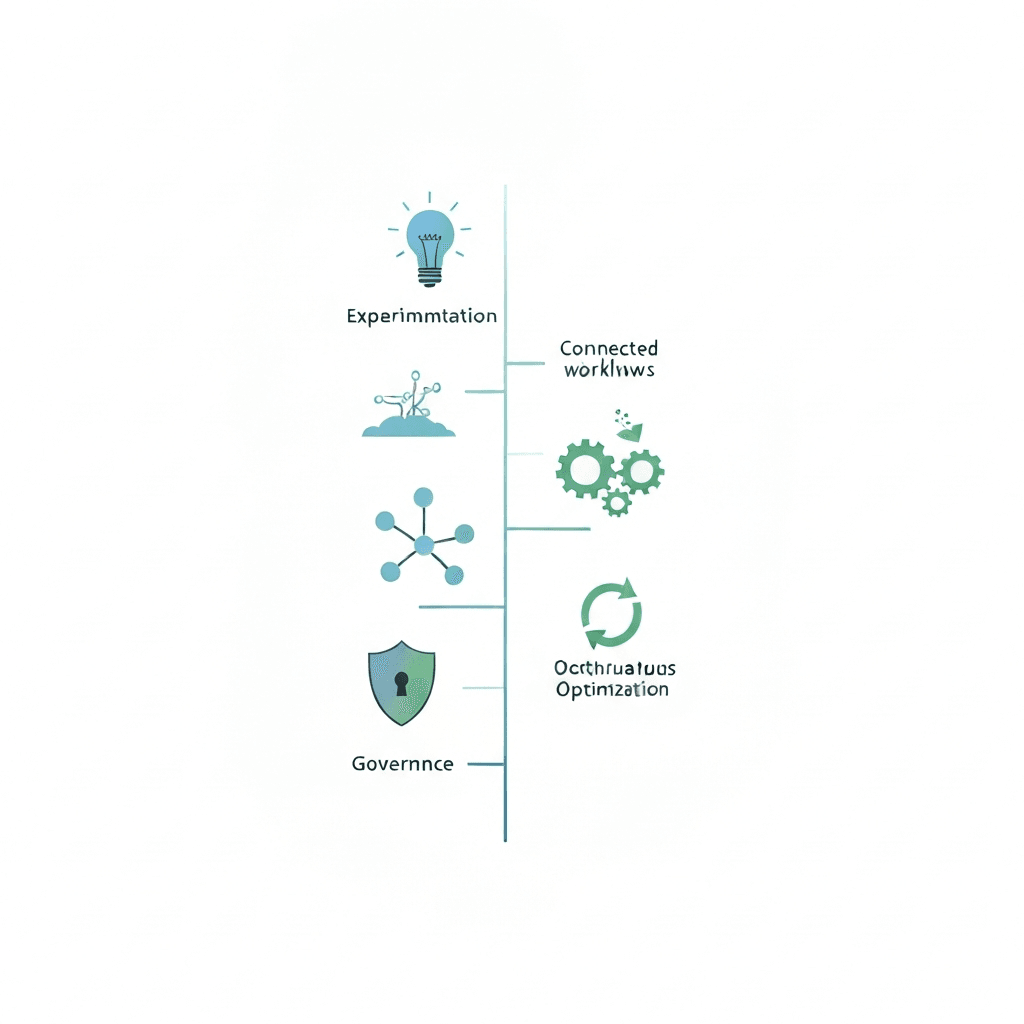
Typical AI maturity stages
- Initiation (individual experimentation)
- Teams try small pilots and personal tools. However, efforts stay isolated. As a result, reuse is limited and impact remains small.
- Development (connected workflows)
- Workflows start to incorporate AI across teams. Therefore, integrations and shared automations appear. This stage improves productivity and reduces manual handoffs.
- Integration (formalized governance)
- Organizations add policy, role based access, and audit trails. Moreover, they standardize prompts, monitoring, and performance metrics. Because governance reduces risk, leaders can scale with more confidence.
- Optimization (adaptive orchestration)
- AI orchestration coordinates tools, agents, and automations end to end. As a result, systems self tune and teams iterate faster. This stage turns AI into operational infrastructure rather than a set of point solutions.
Related concepts include AI orchestration, AI workflows, AI governance, and prompt engineering. For practical trend context, see AI and Technology Trends 2025. To keep expectations realistic, read AI Hype Index Signals. Finally, remember the human role in AI systems: Why Human Agents Remain Foundational in the AI-Enhanced Support Ecosystem.

AI maturity benefits: evidence and real world examples
Organizations gain measurable advantages as they climb AI maturity levels. For clarity, this section maps benefits to stages and gives evidence or brief case summaries. Because facts matter, each example notes ROI, cost savings, or strategic gains.
-
Initiation benefits
- Faster experimentation and early wins. For example, teams using personal generative tools cut content drafting time by up to 50 percent in specific tasks. However, impact often stays localized without reuse.
-
Development benefits
- Connected workflows reduce manual handoffs and speed processes. As a result, companies that automate cross team workflows report higher throughput and fewer errors. Zapier’s platform supports integrations with over 8,000 apps, which lowers integration friction and speeds deployment: Zapier.
-
Integration benefits
- Formal governance reduces risk and compliance costs. For instance, standardizing prompts and audit trails shortens review cycles and lowers remediation costs. In surveys, 78 percent of enterprises say integration challenges remain a top barrier, which shows the value of governance and planning: Zapier AI Resistance Survey.
-
Optimization benefits
- Adaptive orchestration delivers continuous improvement and measurable ROI. Mature programs move from point solutions to operational infrastructure. For example, executive surveys show 98 percent want workers with AI skills, and trained staff are far more productive than untrained peers, which increases labor ROI: Zapier Survey.
Real world summary
- Retail chain example: after moving from pilots to connected workflows, a retailer reduced order processing time by 40 percent. Therefore, they cut labor costs and improved same day fulfillment.
- Support team example: by adding governance and orchestration, a service team improved response consistency. As a result, customer satisfaction rose and escalations fell.
These outcomes show why investing in skills, governance, and orchestration pays off. Moreover, moving up the maturity ladder amplifies automation ROI and reduces integration risk. For a deeper view of AI orchestration and scale, see Zapier’s exploration of AI orchestration.
| Stage Name | Key Characteristics | Common Challenges | Business Outcomes |
|---|---|---|---|
| Initiation | Individual experiments and pilots; personal generative tools; rapid prototyping | Isolated efforts; low reuse; no standards; security gaps | Quick proofs of concept; small time savings; limited enterprise ROI |
| Development | Connected workflows; shared automations; app integrations; repeatable playbooks | Data silos; inconsistent prompts; integration friction; role confusion | Faster processes; fewer handoffs; measurable productivity gains |
| Integration | Formalized governance; role based access; audit trails; monitoring and metrics | Compliance complexity; change resistance; tooling misfit | Lower compliance risk; predictable scaling; reduced remediation costs |
| Optimization | Adaptive orchestration; end to end AI orchestration; feedback loops; self tuning systems | Requires skilled talent; observability and performance monitoring needs; complex integrations | Continuous improvement; higher automation ROI; faster innovation and customer value |
Conclusion: AI maturity as a business differentiator
AI maturity determines whether AI yields strategic advantage or remains a set of isolated tools. Companies that move beyond pilots gain faster decisions, higher automation, and clearer metrics. Therefore, investing in skills, governance, and orchestration matters more than buying technology alone.
Skills and governance close the gap between experiments and scaled outcomes. Moreover, trained employees use AI productively rather than lose time to bad practices. As a result, labor ROI improves and adoption accelerates.
AllosAI helps organizations reach advanced AI maturity without increasing headcount. It automates social media workflows and customer support using orchestrated AI agents and prebuilt playbooks. Furthermore, AllosAI integrates with existing tools, adds observability, and enforces safe access patterns. Learn more on the AllosAI website here and try the platform at this link.
Start with experiments, then formalize governance and hire or train for key roles. For practical guidance and case studies visit the AllosAI knowledge hub here. Follow updates and tips on X this account for product news and examples. In short, AI maturity transforms AI from cost center to growth engine.
Frequently Asked Questions (FAQs)
What does AI maturity mean for my organization?
AI maturity measures how well your organization uses AI across people, processes, and systems. It shows whether AI is a series of pilots or an operational capability. As a result, it helps leaders plan hires, governance, and investments. Higher maturity yields faster decisions and clearer metrics.
What are the main stages of AI maturity?
The four common stages include initiation, development, integration, and optimization. Initiation focuses on individual experimentation. Development creates connected workflows and shared automations. Integration adds governance, audit trails, and monitoring. Optimization uses adaptive orchestration and feedback loops for continuous improvement.
What business benefits come from advancing AI maturity?
Advancing AI maturity delivers measurable benefits. For example, teams reduce manual handoffs and speed processes. Moreover, governance lowers compliance risk and remediation costs. As a result, firms see higher automation ROI, improved customer experiences, and faster innovation.
How long does it take to move between stages of AI maturity?
Timelines vary by company size, data readiness, and talent. Smaller projects move quickly, often within months. However, full integration and optimization can take a year or more. Therefore, plan in phases and measure outcomes at each step.
How can AllosAI help accelerate AI maturity?
AllosAI automates social media and customer support without adding headcount. It provides prebuilt playbooks, observability, and safe access patterns. Consequently, teams gain repeatable workflows and faster time to value. Try the platform at AllosAI platform to evaluate fit.