

AI workflows: Automating ticket triage to save hundreds of hours
Why AI workflows matter for modern support teams
AI workflows transform repetitive support tasks into smart, scalable processes. Because support teams face high ticket volumes, automating triage frees agents for complex problems. As a result, teams improve response times and reduce burnout. AI workflow automation reads messages, classifies intent, extracts key fields, and routes tickets to the right team. This capability goes beyond rigid rules and enables AI orchestration, agentic AI, and no-code automation to handle nuance.
Modern businesses need practical guidance, therefore this article shows how to plan and run pilots. First, we explain how AI agents and automations can triage incoming requests. Next, we outline metrics to track, such as time saved, completion accuracy, and manual interventions. Then, we cover guardrails for privacy, security, and prompt design so you avoid exposing sensitive content. Finally, we offer implementation patterns, from Zapier-powered orchestration to integrating with CRMs and helpdesk tools, plus real-world examples of time and cost savings.
If you lead support or IT, you will find tactical steps to get started quickly. However, the aim is not to sell a single tool. Instead, we focus on reproducible patterns, pilot templates, and decision points. By the end, you will know how to pilot AI-driven ticket triage and scale AI workflows responsibly.
AI workflows: what they are and how they work
AI workflows are automated processes that include one or more AI steps. Because they combine traditional automation with AI, they handle nuance and judgment. They read incoming data, classify intent, extract important fields, and then decide the next action. As a result, teams can route tickets, suggest responses, or trigger followups automatically.
Key features and capabilities
- Natural language understanding and classification so the system reads tickets like an agent. Therefore it can distinguish bug reports from billing questions.
- Data extraction and enrichment so AI pulls names, order numbers, and severity. Then integrations push that data into CRMs or ticketing systems.
- Decisioning and routing so AI chooses the right owner or escalation path. As a result, response times fall and manual triage drops.
- Agentic loops and retry logic so advanced agents can plan, act, evaluate, and try again when needed. This reduces errors and improves outcomes.
- Observability and drift detection so teams monitor accuracy and intervene when models degrade. Because AI workflows are living systems, monitoring prevents silent failures.
How AI workflows operate in practice
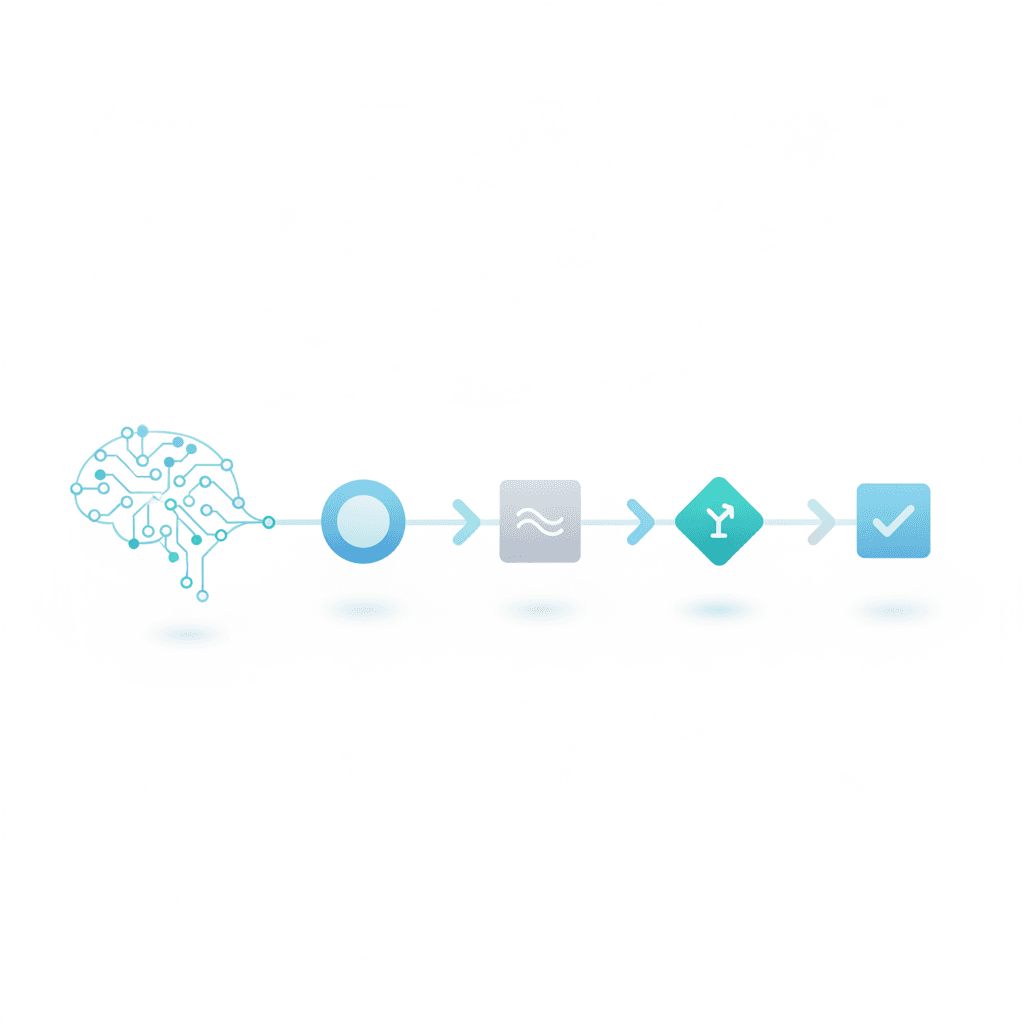
Imagine a customer sends a support message about a failed login. First, an AI workflow reads the message and classifies it as authentication. Next, it extracts the username and device details. Then the workflow checks recent incidents in the ticketing system. If no similar issue exists, it creates a priority ticket and assigns it to the SSO team. Otherwise, it adds a contextual note and nudges the agent with suggested remediation steps.
Why AI workflows matter now
- They save time because they automate repetitive triage and routing tasks.
- They scale knowledge because AI captures patterns across thousands of tickets.
- They reduce burnout because agents handle fewer routine requests.
- They improve accuracy when integrated with AI ready data and governance, which helps avoid privacy mistakes. Learn more about preparing data for automation at this link.
Where to start
Begin with a narrow pilot that automates a predictable ticket type, such as password resets. Then measure time saved, completion rate, and user satisfaction. For guidance on running pilots and making decisions, see how AI agents speed enterprise decisions at this link. Finally, consider orchestration options and templates, for example Zapier Agents, to reduce implementation time: this link.
AI workflows: benefits and practical applications
AI workflows unlock speed, accuracy, and scale across business functions. Because they combine AI with orchestration, teams automate complex decisions, not just tasks. As a result, companies reduce manual triage, improve customer experience, and scale knowledge without hiring at the same rate.
Core benefits
- Faster response times and reduced backlog because AI classifies and routes requests instantly.
- Higher accuracy in routing and prioritization thanks to natural language understanding and context extraction.
- Time savings and cost reductions through automation of repetitive work, which frees skilled staff for higher value tasks.
- Improved customer engagement because personalized replies and proactive follow ups feel timely and relevant.
- Scalable knowledge capture so AI learns patterns across tickets and shares best practices automatically.
- Lower burnout as agents handle fewer routine issues and focus on complex problems.
- Better governance when teams apply guardrails, observability, and prompt hygiene to protect sensitive data.
Practical applications by function and industry
- Support and IT helpdesk: Triage, priority routing, and suggested remediation reduce manual effort.
- Sales and SDR teams: Lead scoring, routing, and enrichment speed follow up and improve conversion.
- HR and onboarding: Automated checklist completion, document parsing, and scheduling accelerate time to productivity.
- Marketing and events: Personalized onboarding sequences and content recommendations boost attendance and retention.
- Finance and operations: Invoice parsing and exception routing cut processing time and errors.
- Healthcare and compliance: Data extraction with strict guardrails speeds workflows while protecting privacy.
Real-world use cases that show impact
- Remote scaled to more than 1,800 employees while their IT team had three people. As a result, AI workflows handled roughly 28 percent of tickets. Consequently the IT team saved over 600 hours per month. This freed them to focus on strategic projects, not just firefighting.
- Popl processed hundreds of form submissions daily and implemented more than 100 workflows. By layering AI workflows into sales and ops, Popl saved roughly twenty thousand dollars per year. Therefore teams moved faster, and leaders saw measurable ROI.
How to pick the right first use case
Start with a high volume, low risk ticket type, such as password resets or billing status checks. Then measure time saved, completion accuracy, and manual interventions. Finally, iterate quickly, add guardrails, and scale what proves reliable. Doing this lets you capture wins fast and build trust in AI orchestration and no code automation.
| Category or Tool | Key features | Typical use cases | Best industries | Pricing or accessibility |
|---|---|---|---|---|
| Zapier Agents (no-code orchestration) | 8,000+ integrations, drag-and-drop builder, prebuilt templates | Ticket triage, lead routing, onboarding flows | SaaS, marketing, sales, support | Free tier, paid plans for teams, enterprise options |
| RPA platforms (UiPath, Automation Anywhere) | UI automation, legacy system connectors, high reliability | Invoice processing, legacy app automation, batch jobs | Finance, HR, operations | Enterprise licensing, professional services often needed |
| Cloud AI APIs (OpenAI, Google) | State-of-the-art models, text and vision, flexible APIs | NLU, summarization, classification, extraction | Any industry with developer resources | Pay-as-you-go API billing, scalable |
| AI-native workflow builders (specialized platforms) | Built-in model steps, observability, prebuilt AI actions | Intelligent forms, automated workflows, agentic tasks | Support, product, operations | Subscription-based, often no-code or low-code |
| Low-code platforms (Microsoft Power Automate, Airtable) | Connectors, templates, GUI builders | Approval flows, data sync, simple automations | Enterprise, SMBs using Microsoft stack | Included or add-on in Microsoft plans, moderate cost |
| Custom in-house pipelines | Full control, custom logic, tailored ML models | Complex decisioning, proprietary data workflows | Tech-first companies, regulated industries | High dev cost, ongoing maintenance required |
Because teams vary, choose the class that fits your team size and risk profile. Then start with a narrow pilot and iterate quickly. Measure time saved and accuracy. Finally, use guardrails to protect sensitive data.
AI workflows are not a novelty. They are a practical lever for cost savings, speed, and better customer outcomes. As a result, organizations can automate routine work while preserving human judgment for complex problems.
AllosAI plays a central role in this shift. The platform offers advanced AI automation tools for content creation, workflow automation, customer engagement, and business intelligence. For example, AllosAI provides external chat support solutions that route conversations and resolve common issues automatically. In addition, its AI writing tools speed content production and maintain consistent brand voice. The platform also integrates with CRMs and syncs data for smarter routing and reporting. Finally, teams can manage conversations in a unified support inbox that reduces context switching and improves agent efficiency.
If you lead support, sales, or operations, explore how AllosAI can accelerate pilots and scale AI workflows. Visit the AllosAI website to learn more: https://allosai.com. Try the app platform for hands-on workflow building: https://app.allosai.com. Read guides and case studies in the knowledge hub: https://allosai.com/blog. Each resource explains implementation patterns, metrics to track, and guardrails for safe automation.
Start small, measure results, and iterate. Because AI workflows are living systems, that approach reduces risk and builds momentum. Move forward with curiosity and discipline, and you will unlock hours of reclaimed time and measurable ROI.
Frequently Asked Questions (FAQs)
What are AI workflows and how do they differ from traditional automation?
AI workflows are automations that include AI-powered steps. They use natural language understanding to read text, extract meaning, and make decisions. In contrast, rule-based automation follows fixed if-then logic. Therefore AI workflows handle nuance, ambiguity, and exceptions. As a result, they route complex tickets, enrich data, and suggest actions that rigid rules cannot.
Is it safe to use AI workflows with sensitive customer data?
Security and privacy matter. Because of that, apply guardrails and data handling rules from day one. Mask or exclude sensitive fields in prompts when in doubt. In addition, use observability to detect drift and unexpected behavior. Finally, run pilots and vet model outputs before enabling full autonomy.
Which teams should pilot AI workflows first?
Start with high-volume, low-risk use cases. For example, password resets, billing status checks, and basic lead enrichment work well. These pilots give fast wins and clear metrics. Then expand to routing, onboarding, and more complex support flows as confidence grows.
How does AllosAI support implementing AI workflows?
AllosAI offers workflow builders, AI writing tools, and external chat support solutions. In addition, it integrates with CRMs and maintains a unified support inbox. As a result, teams can design pilots faster, track results, and reduce context switching across systems.
What metrics should we track and when will we see ROI?
Measure time saved, completion accuracy, manual intervention rates, and customer satisfaction. Also track error patterns and model drift. Typically teams see measurable time savings within weeks during a focused pilot. Therefore iterate quickly and scale what consistently reduces manual work.