

AI Marketing Predictions 2026
AI marketing predictions 2026 point to a major rewrite of how brands find and win customers. By 2026, agentic AI agents will plan, run, and optimize campaigns with minimal human input. As a result, teams will shift from manual execution to strategic oversight and creative judgment.
Generative AI and AI agents will power hyperpersonalization at scale, and marketers will use predictive analytics to anticipate needs. Moreover, agent-to-agent commerce and living campaigns will connect channels and automate cross-sell sequences. However, this shift favors privacy-first data and first-party strategies, because consumers demand control.
Therefore, brands must redesign content for both people and large language models. For example, structured content and multimodal assets will become essential. Also, the 30% Rule will guide sensible automation of routine tasks. Importantly, AI will boost productivity, not just replace jobs, when teams apply human-in-the-loop checks.
Finally, this article maps practical steps, risks, and tools to adopt agent-driven marketing safely and effectively. Additionally, expect competing AI standards like ACP and MCP to emerge.
AI marketing predictions 2026: Key trends to watch
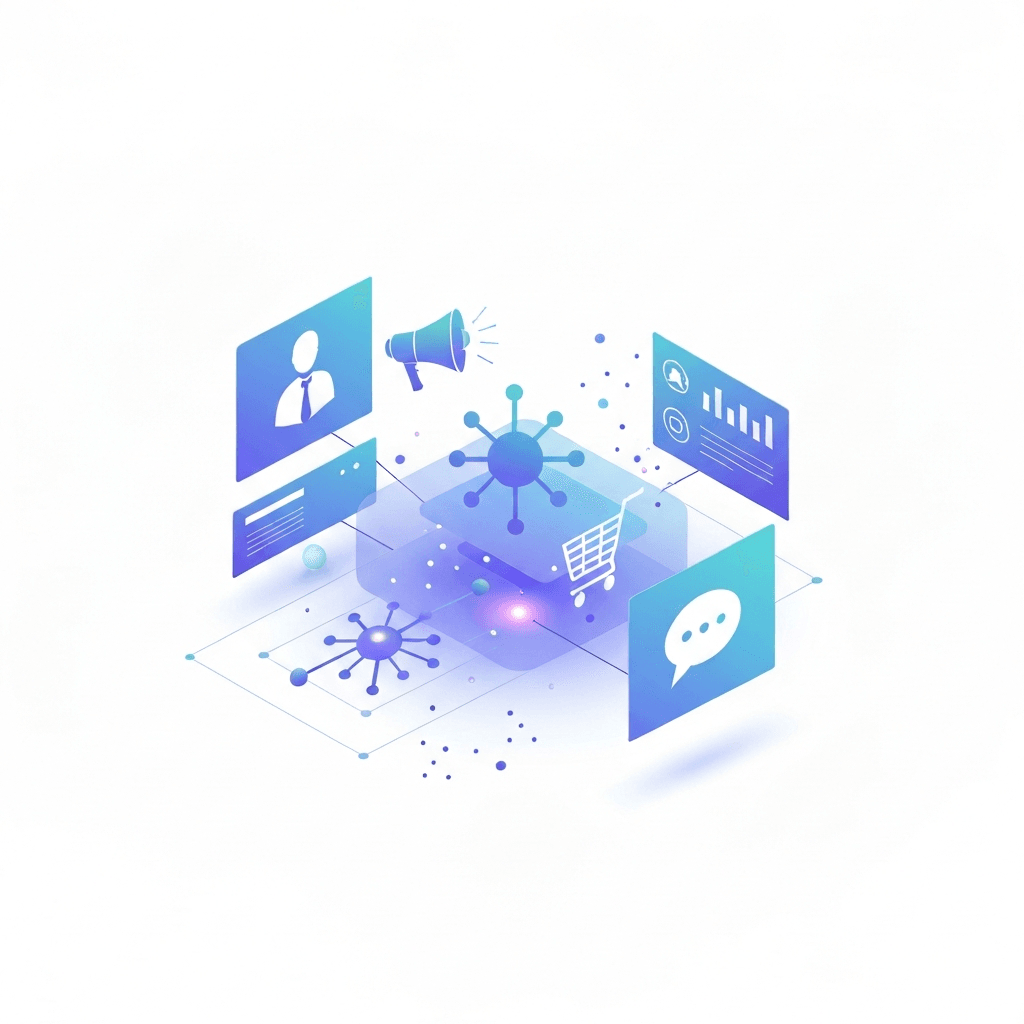
AI automation and marketing technology will reshape strategy and execution by 2026. Below are the major trends to expect, with short explanations and examples.
- Hyper personalization using generative AI and first-party data: Brands will serve dynamic offers and messaging per user. For example, an AI agent can assemble product bundles and A/B test copy in real time.
- Predictive analytics and predictive personalization: Marketers will forecast intent and act before intent peaks. Therefore, teams can push timely promotions based on propensity scores.
- AI driven content creation and content repurposing: Generative models will produce long and short formats, then repurpose them across channels. As a result, content teams will scale and maintain consistent voice.
- Agentic campaigns and agent-to-agent commerce: Autonomous agents will plan, buy, and optimize across platforms. For instance, agents could negotiate cross-sell flows between commerce agents.
- Multimodal assets and structured content for LLMs: Brands must publish audio, video, and structured data. Otherwise, they lose visibility in answer engines and AI search.
- Privacy-first data strategies and human-in-the-loop controls: Teams will favor first-party and zero-party data. However, human oversight will check AI decisions for ethics and brand fit.
- Living campaigns and continuous optimization: Campaigns will evolve automatically based on signals. This reduces manual updates and saves time.
Why these trends matter
These shifts lower acquisition costs and boost relevance. Moreover, they increase efficiency while raising governance needs. For practical tool comparisons on automation, see What makes ActiveCampaign vs Mailchimp better for AI automations? ActiveCampaign vs Mailchimp. Also, HubSpot documented rising AI adoption and strategic changes in 2026: HubSpot State of Marketing.
| Tool Name | Primary Function | Key Features | Benefits |
|---|---|---|---|
| HubSpot Breeze AI suite | Campaign planning and agent orchestration | AI agents, data agent, CRM integration, living campaigns | Runs and optimizes agentic campaigns; supports privacy-first data |
| Google Analytics 4 AI Insights | Analytics and predictive signals | Predictive metrics, anomaly detection, user journey modeling | Forecasts intent; fuels predictive personalization |
| OpenAI ChatGPT (API) | Generative content and conversation | Long-form content, fine-tuning, multimodal support | Scales content; supports multimodal assets |
| Perplexity | AI search and answer engine | Retrieval augmented generation, concise answers, citation support | Improves AEO and answer-first search visibility |
| Allos AI Social Media Agent | Social media automation and agentic posting | Post generation, scheduling agents, cross-channel repurposing | Runs social campaigns and automates repurposing |
| Claude (Anthropic) | Assistant-style LLM for safe workflows | Instruction tuning, guardrails, multimodal inputs | Strong for governance and human-in-the-loop checks |
Practical payoffs of AI marketing predictions 2026
Adopting AI automation and marketing technology delivers clear, measurable benefits. First, teams reclaim time because AI handles repetitive tasks. As a result, staff focus on strategy and creative work. In practice, tools that automate reporting and A B testing save weeks of effort each quarter.
Operational efficiency
- Faster execution and lower costs: AI agents automate campaign orchestration, so teams run more tests with fewer resources.
- Reduced burnout and stress: When AI takes routine work, marketers spend more time on high-value projects.
Enhanced customer engagement
- More relevant experiences: Hyper personalization tailors messaging per user, which increases conversion and loyalty.
- Better timing and context: Predictive analytics send offers before intent peaks, improving response rates.
Data driven decision making
- Real time insights: AI surfaces anomalies and opportunities, therefore teams react faster.
- Smarter allocation: Predictive signals guide budget shifts across channels to maximize ROI.
A short hypothetical case
A mid size retailer used agentic campaigns in 2026. Consequently, the team saved about 12 hours per week. Also, personalized offers lifted conversion by nearly 18 percent. The brand kept humans in the loop to review ethics and creative direction.
Why this matters now
These payoffs reduce stress, speed growth, and build competitive advantage. However, brands must combine first party data with human oversight. Therefore, apply the 30 percent Rule to automate routine work while protecting judgment and brand trust.
AI Marketing Predictions 2026
AI marketing predictions 2026 point to agentic systems running campaigns end to end. Therefore marketers will shift from manual execution to strategy and judgment. Marketers who act now will gain advantage and lower acquisition costs.
AllosAI shows how this works in practice. The AllosAI platform automates social media and support functions, reducing workload and costs without growing headcount. Because AllosAI orchestrates content, schedules posts, and handles routine queries, teams reclaim time for creativity. This article outlined practical trends, tool choices, and governance steps.
Use first party data and human oversight alongside automation. As a result, brands gain speed and trust. Moreover, the 30 percent Rule helps balance efficiency with judgment. Human in the loop reviews will protect brand values and ethics.
Learn more at AllosAI. Try the app at AllosAI App. Read guides at AllosAI Blog. Follow updates on X at AllosAI on X.
The future is practical, human centered, and agent empowered. Stay optimistic and start small, because measured adoption wins.
Frequently Asked Questions (FAQs)
What implementation challenges should I expect when adopting the AI marketing predictions 2026?
Integration with legacy systems and poor data quality cause delays. Also, teams need new skills and governance. Start small and focus on high impact pilots. Use the 30% Rule to limit automation and retain human judgment. Finally, choose tools with open APIs and clear controls.
How quickly will I see ROI from AI marketing?
Many teams report time savings within weeks. For example, tools can save 10 to 14 hours per week. Therefore you may see cost benefits in a few months. Also, conversion lifts from personalization can compound ROI over time.
What about ethics and privacy concerns?
Use first party and consented data. Moreover, add human-in-the-loop checks and audit trails. Vendors should offer guardrails and explainability. As a result, you protect customers and reduce legal risk.
Will AI replace marketing jobs?
AI automates routine tasks, but it rarely replaces strategic roles. Instead, roles shift toward strategy, creativity, and oversight. Upskilling teams makes the transition smoother.
How can I future proof my stack?
Favor modular tools and open standards like ACP or MCP. Also, design for living campaigns and continuous learning. Therefore you remain adaptable to new models and channels.