

Future of AI (2030): Transformations Ahead
Imagine a world where software writes drafts, labs design drugs, and humanoid robots help at home. The Future of AI (2030) will reshape work, products, and daily life. Already, generative AI and large language models power new tools. However, adoption will differ across regions and income levels.
This article explores likely shifts in compute, model design, and product strategy. We examine foundation models, open-source weights, AI agents, and robotics. Because policy and funding will affect access, inequality may rise. At the same time, efficiency gains could boost productivity for many.
Read on for practical scenarios, skeptical takes, and product implications. We highlight risks, opportunities, and steps teams can take. Therefore, you will leave with clear ideas to plan for 2030. Meanwhile, expect surprises along the way.
We base findings on current trends in LLMs, robotics, and policy. Because uncertainty remains high, we prioritize practical strategies. As a result, product leaders can start testing features today.
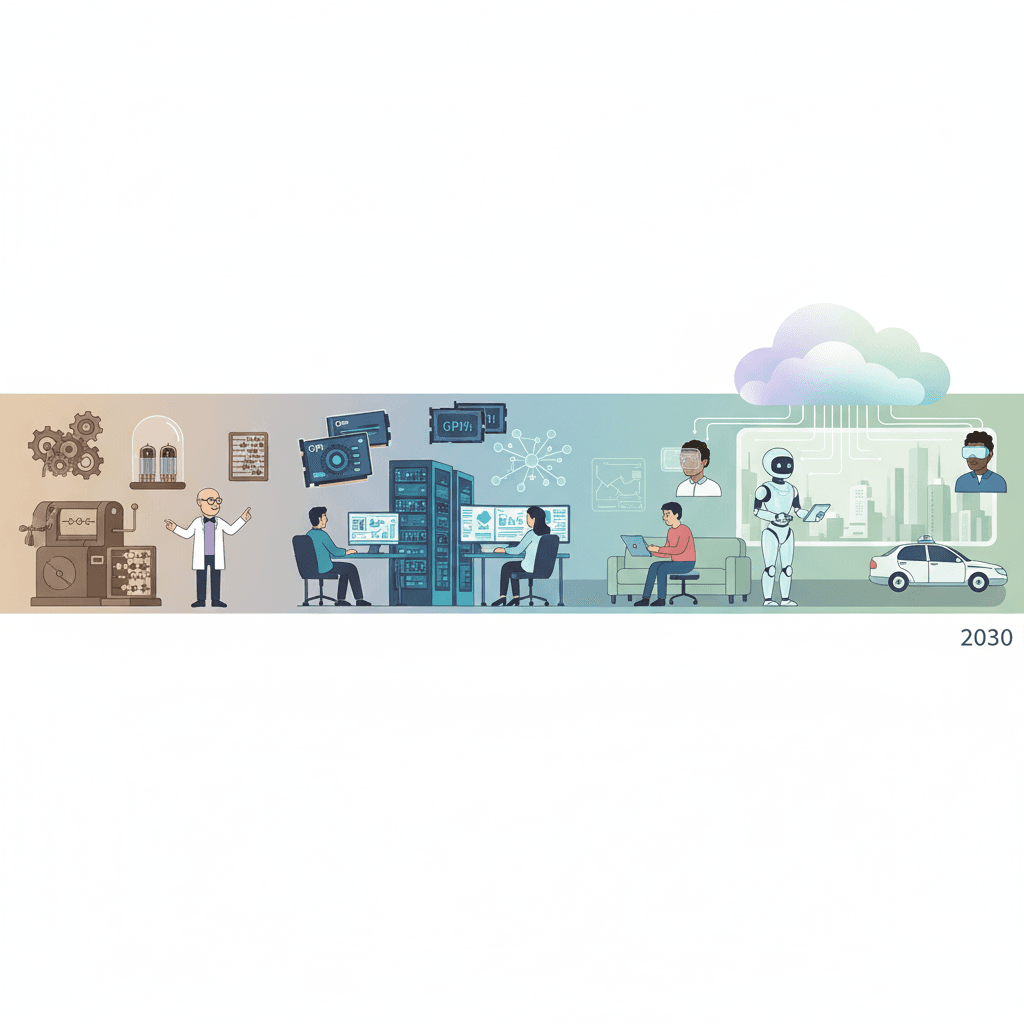
Emerging Trends in the Future of AI (2030)
The Future of AI (2030) will unfold along several clear trends that affect products and society. Because progress moves quickly, teams must watch innovation, automation, and social impact closely.
- Foundation models and open-weight systems: Large language models will grow more capable. As a result, firms will reuse foundation models for many tasks. For example, a single model could power customer support, content creation, and legal summaries.
- AI automation and intelligent systems: Automation will move beyond scripts into autonomous agents. For example, AI agents may schedule meetings, debug code, and manage supply chains.
- Compute efficiency and edge AI: Chips and model pruning will reduce costs. Therefore, devices at the edge will run intelligent systems without constant cloud access.
- AI breakthroughs in healthcare and science: Generative models will accelerate drug discovery and diagnostics. For instance, labs can simulate molecules faster than before.
- Robotics, robotaxis, and everyday bots: Humanoid robots and robotaxis will emerge in niche markets. However, adoption will vary by region and income.
- Policy, inequality, and access: Adoption spreads unevenly, as Microsoft’s AI Diffusion report shows. See Microsoft’s AI Diffusion Report for details.
Product teams can prototype with tools like AI Chat. Meanwhile, expect surprises and strategic tradeoffs.
AI Technologies Comparison (2030)
| Technology Name | Key Features | Industry Applications | Expected Impact |
|---|---|---|---|
| Foundation models (LLMs) | Massive pretraining; transfer learning; few-shot learning. | Chatbots; search; content creation; coding assistants. | Core building block for many products. High productivity gains. Centralizes compute and data power. |
| Generative AI | Multimodal output; creative synthesis; controllable generation. | Marketing; media; drug design; simulation. | Automates creative work. Therefore it speeds workflows and cuts costs. |
| AI Agents | Task planning; autonomous decision loops; API orchestration. | Virtual assistants; DevOps; supply chains. | Replaces routine work. However, oversight remains essential. |
| Edge AI and TinyML | Low-power models; on-device inference; latency reduction. | IoT; mobile apps; industrial sensors. | Enables privacy and resilience. As a result, costs drop for many uses. |
| Reinforcement learning and world models | Long-horizon planning; simulation-driven learning. | Robotics; autonomous systems; game theory. | Better real-world control. Meanwhile, sample efficiency limits remain. |
| Robotics and humanoid robots | Manipulation, perception, mobility. | Warehousing; caregiving; retail. | Transforms labor in niches. Adoption will vary by region. |
| Autonomous vehicles and robotaxis | High-definition perception; mapping; safety stacks. | Transport; logistics; ride hailing. | Could reshape cities. However, rollout is gradual. |
| Explainable and causal AI | Transparent models; counterfactual reasoning. | Healthcare; finance; compliance. | Builds trust and reduces risk. Therefore regulators may favor these systems. |
| Open-weight models and open-source AI | Shared weights; community innovation. | Research; startups; education. | Lowers entry barriers. As a result, competition rises. |
| Specialized accelerators and chips | Energy-efficient inference; mixed precision hardware. | Data centers; edge devices; robotics. | Cuts compute costs. Therefore more firms can deploy large models. |
Advanced AI Applications and Their Benefits
By 2030, AI will move from prototypes to daily tools. Across industries, intelligent systems will boost efficiency and cut errors. Because models learn from vast data, accuracy will improve over time.
- Healthcare: AI diagnoses medical images faster and with fewer false positives. As a result, clinicians treat patients earlier and with more confidence.
- Drug discovery: Generative models simulate molecules and trim years from pipelines. For instance, teams can shortlist drug candidates in weeks rather than months.
- Manufacturing: Intelligent systems predict equipment failures and schedule maintenance automatically. Therefore production lines run with less downtime.
- Customer experience: Chatbots and AI agents resolve routine queries and escalate complex issues to humans. This approach improves satisfaction and reduces support costs.
- Education: Personalized tutors adapt lessons to each learner, so students receive the right challenge at the right time.
- Transportation: Robotaxis and optimized logistics lower costs and emissions. However, rollout will vary across cities and countries.
- Creative work: Generative AI drafts designs, music, and marketing assets to speed iteration for creators.
Key benefits
- Efficiency: Automates routine tasks and frees skilled workers.
- Accuracy: Reduces human error in critical workflows.
- Enhanced user experience: Personalization at scale improves outcomes and retention.
- Accessibility: Democratizes expert knowledge for more people.
However, teams must design responsibly and address inequality to ensure broad benefit.
Conclusion
The Future of AI (2030) promises broad change across products, work, and society. Because foundation models and AI agents scale, teams will gain new productivity levers. However, inequality and policy will shape who benefits most. This article highlighted trends, technologies, and practical steps for product teams.
AllosAI helps businesses capture that promise as an advanced AI automation platform. It powers intelligent content creation, workflow automation, and AI-powered customer engagement. Explore AllosAI at AllosAI. Read research and guides at AllosAI Blog. Follow updates on X AllosAI on X.
Start small, test realistic use cases, and measure outcomes. As a result, organizations can unlock efficiency, accuracy, and better experiences. Meanwhile, design with equity and oversight in mind. The road to 2030 carries uncertainty, but practical steps today can deliver meaningful impact. Act now to prepare. The Future of AI (2030) rewards thoughtful preparation.
Frequently Asked Questions (FAQs)
What is the Future of AI (2030) likely to look like?
By 2030, AI will be more integrated into daily tools. Foundation models and AI agents will power many services. However, access will vary across regions and income levels.
Will AI replace human jobs?
AI will automate routine tasks, so some roles will change. Meanwhile, new jobs will appear in oversight, model tuning, and AI product design. Therefore, reskilling matters for workers and firms.
How will AI improve healthcare and science?
Generative models will speed drug discovery and diagnostics. As a result, labs can test more hypotheses faster. This change boosts accuracy and reduces time to market.
Are there major risks to expect by 2030?
Yes. Inequality in access is a key risk, and so are bias and misuse. Because of that, policymakers and companies must enforce guardrails and transparency.
How can businesses prepare now?
Start with small, measurable pilots. Use human oversight and clear metrics. Then scale what works, because iterative testing reduces risk and increases impact.